
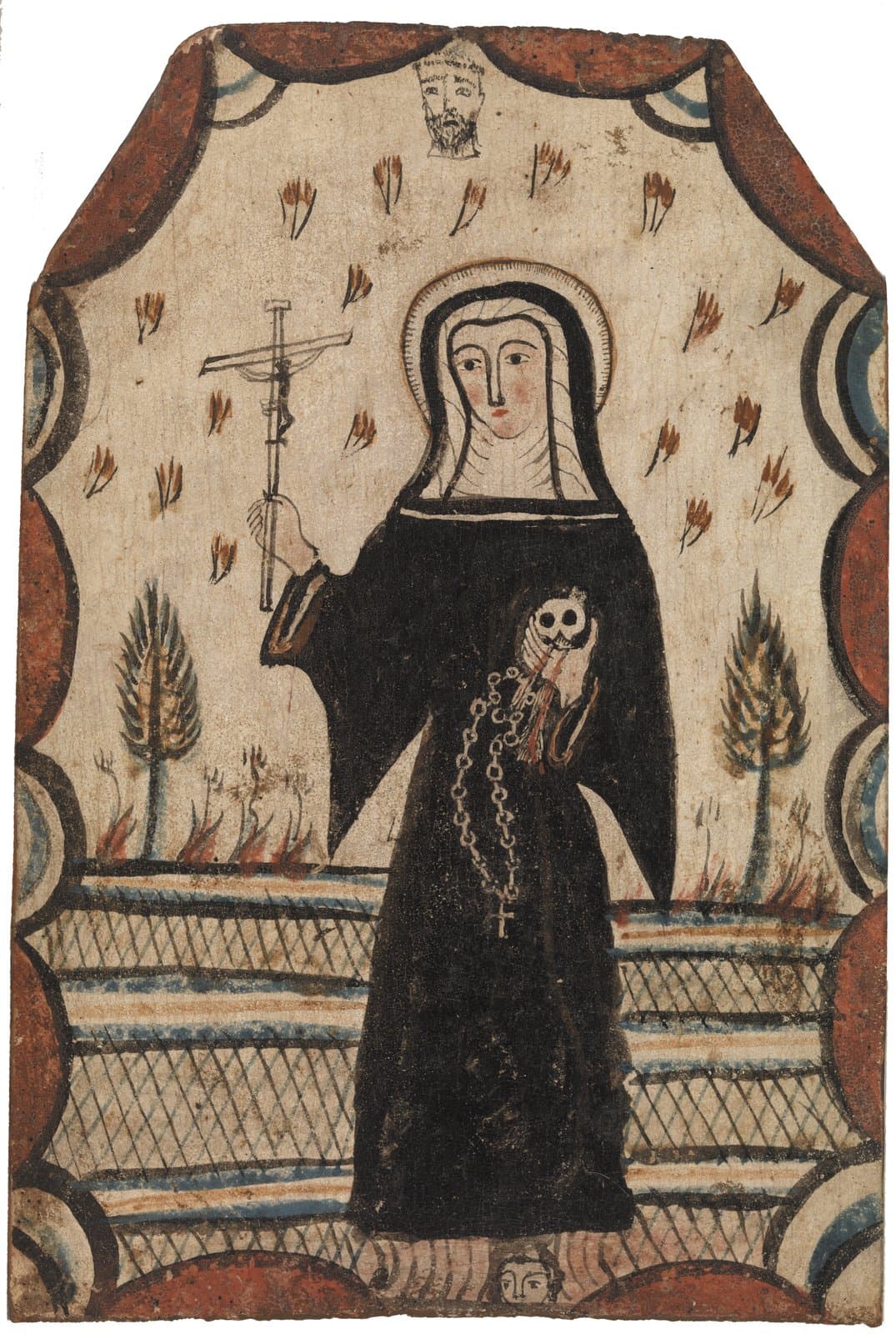
St. Rita
of Cascia: The Patron Saint of Impossible Causes
1381 – 1457
“Santa dei casi impossibili — "Saint of the Impossible"”
Saint Rita of Cascia, painting by Pedro Antonio Fresquís, 1749–1831, Barnes Foundation · Public Domain
Why She Matters
Rita shows that a life marked by an abusive marriage, sudden widowhood, and the death of both her children was not disqualified from deep holiness — it became, instead, the very reason people now turn to her when their own situation feels beyond hope. She matters to survivors of difficult marriages, to grieving parents, and to anyone facing a situation they have been told is impossible.
Virtue for Today
Perseverance in Suffering
Try Today
Bring the situation in your life that feels most "impossible" honestly to God in prayer today, naming it specifically rather than vaguely.
A Forced Marriage
Rita was born around 1381 in Roccaporena, a small village near Cascia in central Italy. From childhood she reportedly wanted to enter religious life, but her parents, following the custom of the time, arranged her marriage instead, and Rita was married at around age twelve to a man named Paolo Mancini. By multiple accounts he was quick-tempered, unfaithful, and at times physically abusive, and the marriage that followed was difficult for close to two decades. Rita bore two sons during this period and, according to tradition, met her husband's cruelty with patience and prayer rather than retaliation, gradually softening his temperament in his later years.
Widowed and Bereaved
After roughly eighteen years of marriage, Paolo was murdered, reportedly the victim of a long-running local feud. Rita's grief was compounded by fear for her two sons, who by the custom of the era were expected to avenge their father's death — a fear that proved well founded, as both sons apparently intended to do exactly that. Rita prayed, according to tradition, that God would prevent her sons from committing murder even if it meant taking their lives instead; both sons then died of illness within roughly a year, before they could carry out any act of revenge. Widowed, childless, and in her mid-thirties, Rita had lost, in a short span of years, nearly everyone closest to her.
The Augustinian Nun Who Wasn't Supposed to Be Admitted
Free of her marital obligations, Rita sought to enter the Augustinian convent of St. Mary Magdalene in Cascia, only to be turned away, according to tradition, because the community required candidates to be unmarried virgins and because her late husband's unresolved feud made her association a liability for the convent. She was eventually admitted around 1407, after — according to a well-known but historically unverifiable legend — miraculously reconciling the warring families involved in her husband's death, removing the community's objection. Once admitted, she lived a life of strict penance and service within the convent for roughly the next forty years.
The Wound of the Crown of Thorns
In 1441, after hearing a sermon on the crown of thorns and praying to share in Christ's suffering, Rita reportedly received a small wound on her forehead that never fully healed for the rest of her life — understood by her community and later devotion as a partial, mystical participation in Christ's Passion. The wound was said to be painful, foul-smelling, and disfiguring enough that she was largely secluded from her community for a time, though later accounts describe periods when it inexplicably healed for events such as pilgrimages. She died on May 22, 1457, in Cascia. Her body, reported by the community to have remained incorrupt, is still venerated in the Basilica of Santa Rita in Cascia. She was canonized in 1900 by Pope Leo XIII and remains one of the most widely invoked saints for what tradition calls "impossible" or seemingly hopeless situations — abusive marriages, infertility, grief, and desperate causes of every kind.
Helper
Reflection Questions:
- Rita met nearly two decades of a difficult marriage with patience rather than retaliation, and tradition credits that patience with eventually softening her husband. Is there a difficult relationship in your life where a different, steadier response than the one you default to might change something over time?
- She lost her husband to violence and both her sons to illness within a short span of years. What loss in your own life still feels unresolved, and have you brought it honestly to prayer rather than only trying to move past it?
- Rita was initially turned away from the religious life she had wanted since childhood, and had to wait years before being admitted. Is there a calling or goal in your life you have had to wait for far longer than you expected?
- She asked, in effect, for God to prevent a worse outcome (her sons becoming murderers) even at real personal cost (their deaths). Have you ever had to pray for an outcome that was painful but still better than the alternative?
- Rita is invoked specifically for "impossible" causes — situations that seem to have no realistic path forward. What is the one situation in your life right now that feels most impossible, and have you named it specifically in prayer?
Short Prayer
“St. Rita of Cascia, Saint of the Impossible, pray for us in the situation that feels beyond hope. Amen.”
Prayer to St. Rita of Cascia
Prayer to St. Rita of Cascia St. Rita, you endured a difficult marriage with patience, buried a husband taken by violence, and lost both your sons within a single year — and still, out of all of it, you built a life devoted entirely to God rather than to bitterness. You carried a wound for the rest of your life as a sign of your union with Christ's own suffering. Pray for anyone enduring an abusive or painful marriage right now, and for every parent grieving a child. Intercede for us in whatever situation in our own lives currently feels impossible, hopeless, or beyond any human solution. Teach us that no loss is so total it closes off the possibility of a holy and even fruitful second half of life. St. Rita, Saint of the Impossible, pray for us. Amen.
The Catholic Company — "St. Rita of Cascia: Patron Saint of the Impossible"; Catholic Exchange — "St. Rita of Cascia: A Patron for Impossible Causes"
Grow closer to God.
Agnioz is here to walk with you.
Register for FREE and unlock more Catholic content, prayers, and reflections to help you become a more enlightened Catholic — FREE FOREVER.


Let's grow together in faith, hope, and love. 🙏