
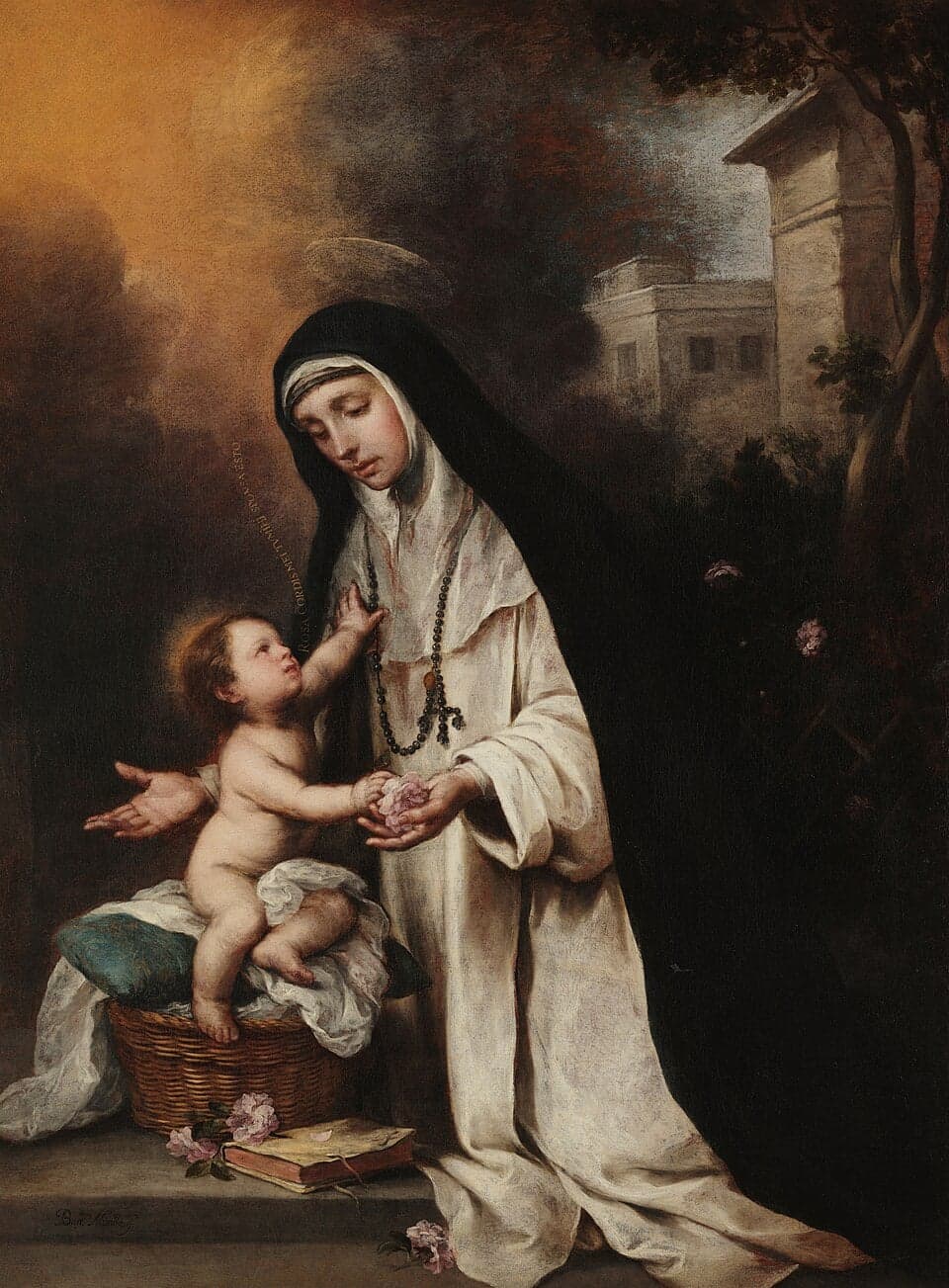
St. Rose
of Lima: The Cross as the Only Ladder to Heaven
1586 – 1617
“Aside from the cross, there is no other ladder by which we may get to heaven.”
Why She Matters
As the first canonized saint of the Americas, Rose of Lima shows that holiness can flourish outside convent walls, in ordinary households, through quiet service to the poor and firm resistance to a life others have already planned out for you.
Virtue for Today
Sacrificial love — embracing hardship and self-denial not for its own sake, but as a way of uniting her life to Christ's.
Try Today
Do one small, unglamorous act of service today for someone your community tends to overlook — the elderly, the sick, or the poor.
A Child Named for Beauty, Who Chose Thorns
Isabel Flores de Oliva was born in Lima, Peru, in 1586, to Spanish colonial parents of modest means. As an infant, her face was said to have briefly taken on the appearance of a rose, and the nickname stuck so completely that "Rose" became the name she was confirmed under and the only name history remembers her by. Everyone around her treated her beauty as an asset to be used — most obviously, by her parents, who saw it as their daughter's best chance at a marriage that would help the family's finances.
Rose had other plans, formed early and held with startling firmness for someone still a child. She cut her own hair short and rubbed pepper into her skin to spoil the complexion so many people praised, precisely so that beauty could not be used to arrange a marriage she had no intention of accepting. It was the opening move in what became a lifelong, deliberate refusal to let her body's appearance decide her future.
The Garden Cell and the Poor of Lima
Rather than enter a convent, which her family could not afford to support her into, Rose built herself a small hut in the family garden — by some accounts assembled with her own hands — where she spent long hours in prayer and solitude while still living, technically, at home. She became a lay member of the Third Order of St. Dominic, taking St. Catherine of Siena, another laywoman famous for radical penance and fierce independence, as her explicit model.
But Rose's life was never simply private austerity. By day, she worked — sewing and growing flowers to sell — to help support her financially struggling family, and she turned a room of the family home into a makeshift clinic, nursing the sick, the elderly, and poor and indigenous Peruvians whom colonial Lima's official charity largely overlooked. She is remembered as one of the earliest documented practitioners of what would later be called social work in the Americas, decades before the term existed, treating the people her city was most inclined to ignore as though they were Christ himself — because she was entirely convinced they were.
A War Against a Wanted Marriage
Her parents did not surrender easily. For years, they pressed Rose toward marriage, at one point even attempting to arrange one directly, and Rose resisted with the same stubbornness she had shown as a child — not through defiance for its own sake, but because she had made a private vow of virginity at a young age and considered herself already committed to Christ in a way no earthly proposal could improve on. The conflict was real and sustained; sanctity, in Rose's life, did not mean her family simply understood and got out of the way. It meant enduring years of pressure from people who loved her and genuinely believed they knew what was best for her future.
Suffering as a Path, Not a Punishment
Rose is remembered, sometimes uncomfortably to modern readers, for the sheer intensity of her physical penances: fasting far beyond what her body could easily sustain, wearing a spiked metal crown hidden under a wreath of roses so that no one would see the suffering she offered privately to God, sleeping on broken glass and thorns by some accounts. Later spiritual directors and even some of her own confessors worried at times that she pushed these practices too far, and the Church has never held up the specific severity of her penances as a template for ordinary believers to copy line by line.
What the Church has always held up is the reasoning underneath them, expressed in the words most closely associated with her: "Aside from the cross, there is no other ladder by which we may get to heaven." For Rose, suffering was never sought as an end in itself or as proof of her own strength. It was accepted, deliberately, as a way of uniting her own small life to Christ's much larger sacrifice — a hard teaching, but one rooted in the plainest reading of the Gospel's own insistence that whoever would follow Christ must take up a cross (Matthew 16:24).
The First Canonized Saint of the Americas
Rose died in 1617 at only thirty-one, and Lima is said to have given her a funeral befitting a public figure rather than a private laywoman — city officials reportedly had to take turns carrying her coffin because so many people wanted the honor. She was canonized in 1671 by Pope Clement X, becoming the first person born in the Americas to be formally recognized as a saint by the Catholic Church — a milestone that made her, almost immediately, patroness not just of Peru but of the whole of Latin America, as well as of the Philippines, and of florists and gardeners, in a gentle nod to the name and the flowers she spent her short life growing and selling to feed the poor she served.
Helper
Reflection Questions:
- Rose deliberately disfigured the beauty everyone praised her for, so it could not be used against her own sense of vocation. What does the world praise you for that sometimes gets in the way of what you actually feel called to?
- Her family's pressure toward marriage came from real love, not malice, yet she still had to resist it for years. Where in your life do you need to hold a conviction firmly against people who love you but don't yet understand it?
- Rose turned her home into a clinic for people her city overlooked. Who is overlooked in your own community, and what small, practical thing could you do for them this week?
- "Aside from the cross, there is no other ladder by which we may get to heaven." Where in your life have you been trying to find a way around a necessary difficulty, rather than through it?
Short Prayer
“St. Rose of Lima, you chose the cross over comfort and the poor over praise. Teach me to embrace the hard, quiet duties of today as a real path to holiness. Amen.”
Prayer to St. Rose of Lima
St. Rose of Lima, first flower of holiness from the New World, you refused the marriage and the ease your family wanted for you, choosing instead a hidden life of prayer and service to Lima's poorest and most overlooked. Teach me that suffering accepted for love of Christ is never wasted, and that no state of life — however ordinary or however hemmed in by others' expectations — is too small a place to become a saint. Obtain for me your same firm devotion to Christ above every other claim on my life. Amen.

Grow closer to God.
Agnioz is here to walk with you.
Register for FREE and unlock more Catholic content, prayers, and reflections to help you become a more enlightened Catholic — FREE FOREVER.


Let's grow together in faith, hope, and love. 🙏