
St. Sebastian: The Soldier Behind the Arrows
? – 288
“Athleta Christi — "Athlete of Christ" (a traditional early Christian title applied generally to martyrs, including Sebastian; no first-person quotation from him survives)”
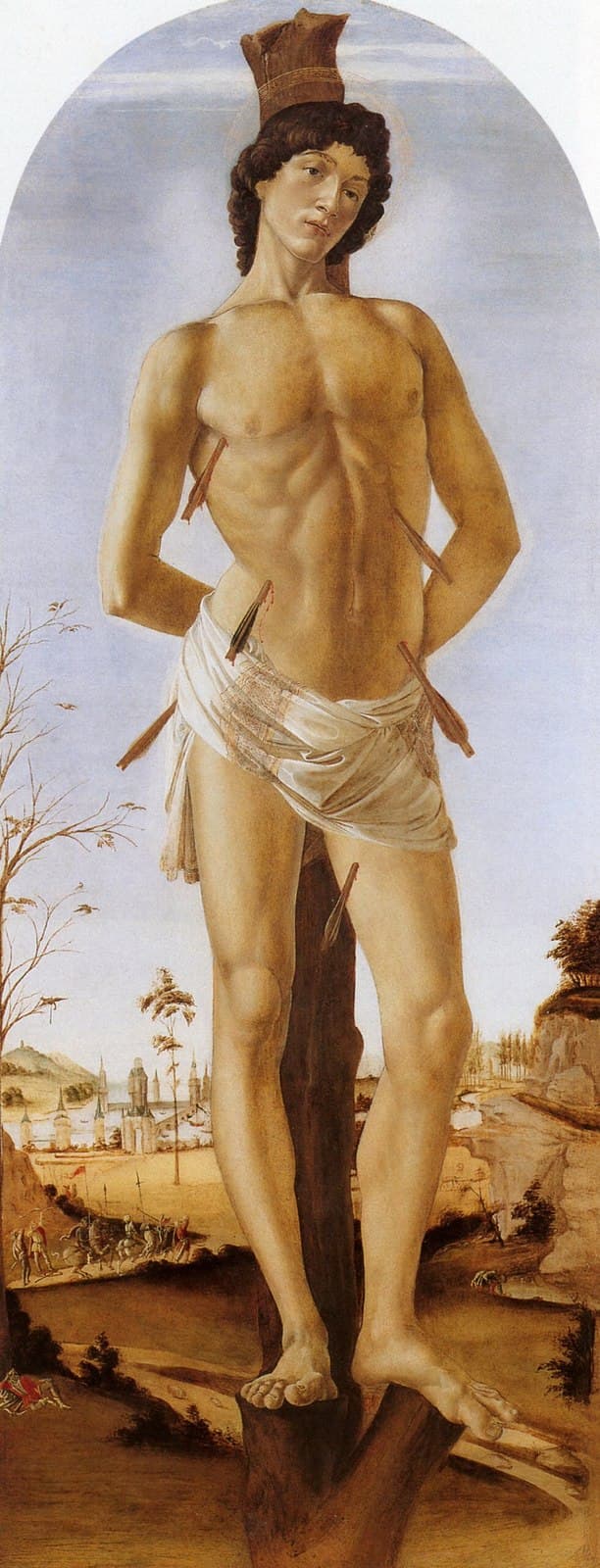
Saint Sebastian, painting by Sandro Botticelli, 1474, Gemäldegalerie, Berlin · Public Domain
Why He Matters
Sebastian shows how a real but thinly documented early martyr became, through centuries of legend, art, and plague-era devotion, one of the most enduring symbols of survival and steadfastness under attack in the whole Christian tradition.
Virtue for Today
Steadfastness
Try Today
Reach out today to someone facing a hidden struggle, illness, or hardship, offering support the way Sebastian's legend describes him quietly aiding persecuted Christians at real risk to himself.
What Can Actually Be Confirmed
Sebastian is one of the best-known martyrs in Christian art, yet the Catholic Encyclopedia is direct about how little of his popular story can actually be verified: "little more than the fact of his martyrdom can be proved." What is genuinely documented is narrow but real. The "Depositio martyrum," a Roman liturgical calendar compiled in 354, records his burial on the Via Appia. St. Ambrose, writing in the fourth century, testifies that Sebastian came from Milan and was already venerated there in his own time, evidence of a real and reasonably early cult. By 367, a basilica had been built over his tomb on the Appian Way, one of Rome's seven great pilgrimage churches, confirming that devotion to him was well established within a few generations of his death.
The Legend Layered On Top
The vivid narrative most people associate with Sebastian, that he was a high-ranking officer in the emperor's personal bodyguard who secretly aided persecuted Christians, was discovered and condemned to be shot with arrows by Mauretanian archers, miraculously survived and was nursed back to health by a widow named Irene, then confronted the emperor directly and was finally beaten to death with clubs, comes from Acts composed around the fifth century, roughly a hundred years or more after any plausible date of his death. The Catholic Encyclopedia calls these Acts "unhistorical and not worthy of belief" as a factual record, even while acknowledging they were tremendously influential devotionally. Tellingly, the earliest surviving artistic depiction of Sebastian, a mosaic from around the year 682, shows him as a mature, bearded man in ordinary court dress, with no arrows at all; the famous image of a young, half-clothed archer's target did not become standard until the Renaissance, more than eight centuries later.
From Forgotten Detail to Renaissance Icon
Sebastian's transformation into one of art history's most frequently painted saints happened gradually and for reasons that had little to do with verifying his biography. Because the legendary Acts describe him surviving a first attack, medieval Christians came to associate him with recovery from otherwise deadly wounds, and by extension with protection from plague, since plague deaths were sometimes imagined, in period art and poetry, as arrows shot by an angry heaven. Sebastian's cult as a plague saint, invoked across Europe during repeated epidemics from the Black Death onward, is itself a well-documented and significant piece of medieval and early modern religious history, entirely real as a devotional phenomenon, even though it rests on a foundational narrative the Church's own scholars regard as legend rather than fact.
A Feast Kept Despite the Uncertainty
None of this historical thinness has diminished Sebastian's place in the Church's calendar or popular devotion; his feast, January 20, has been observed continuously for over sixteen centuries, resting on the genuine early cult in Rome and Milan rather than on the details of the later Acts. He remains patron of soldiers, athletes, archers, and, historically, of plague sufferers, a patronage built as much on centuries of accumulated devotion as on any verifiable fact about the man himself.
Helper
Reflection Questions:
- Sebastian's actual documented history is thin, yet devotion to him shaped centuries of art, prayer, and plague-time comfort. Can a tradition be spiritually meaningful even where the specific facts underneath it can't be verified? Where do you draw that line?
- In the legend, Sebastian secretly aided persecuted Christians while outwardly serving in the emperor's own guard. Is there a place in your life where quiet, hidden loyalty to your faith might cost you more than an easy, public one would?
- The legend describes him surviving one attack only to be martyred by a second. Have you ever survived a setback only to face a harder one right afterward, and how did you respond the second time?
- Devotion to Sebastian grew for centuries around people's real fear of plague and sudden death, not around confirmed history. What fears in your own life do you bring to prayer, even when you can't fully explain or control them?
- The earliest image of Sebastian shows a calm, dressed, mature man, nothing like the dramatic later paintings. Where might popular imagination have reshaped your own picture of a person, event, or belief further than the evidence actually supports?
Short Prayer
“St. Sebastian, pray for us — that we may stand firm in faith even when it is dangerous or costly to do so. Amen.”
Prayer to St. Sebastian
Prayer to St. Sebastian St. Sebastian, the little that is truly known of your life shows a man venerated early and widely for your martyrdom, and the centuries of legend that grew up around your name gave hope to countless Christians facing plague, danger, and sudden death long after you were gone. Pray for us in our own hidden struggles and in whatever we fear will overwhelm us. Give us the steadfastness attributed to you: to keep faith quietly and firmly, whether or not anyone around us ever fully understands what we're carrying. St. Sebastian, soldier and martyr, pray for us. Amen.
Catholic Encyclopedia (New Advent) — "St. Sebastian"; Depositio Martyrum, A.D. 354
Grow closer to God.
Agnioz is here to walk with you.
Register for FREE and unlock more Catholic content, prayers, and reflections to help you become a more enlightened Catholic — FREE FOREVER.


Let's grow together in faith, hope, and love. 🙏