
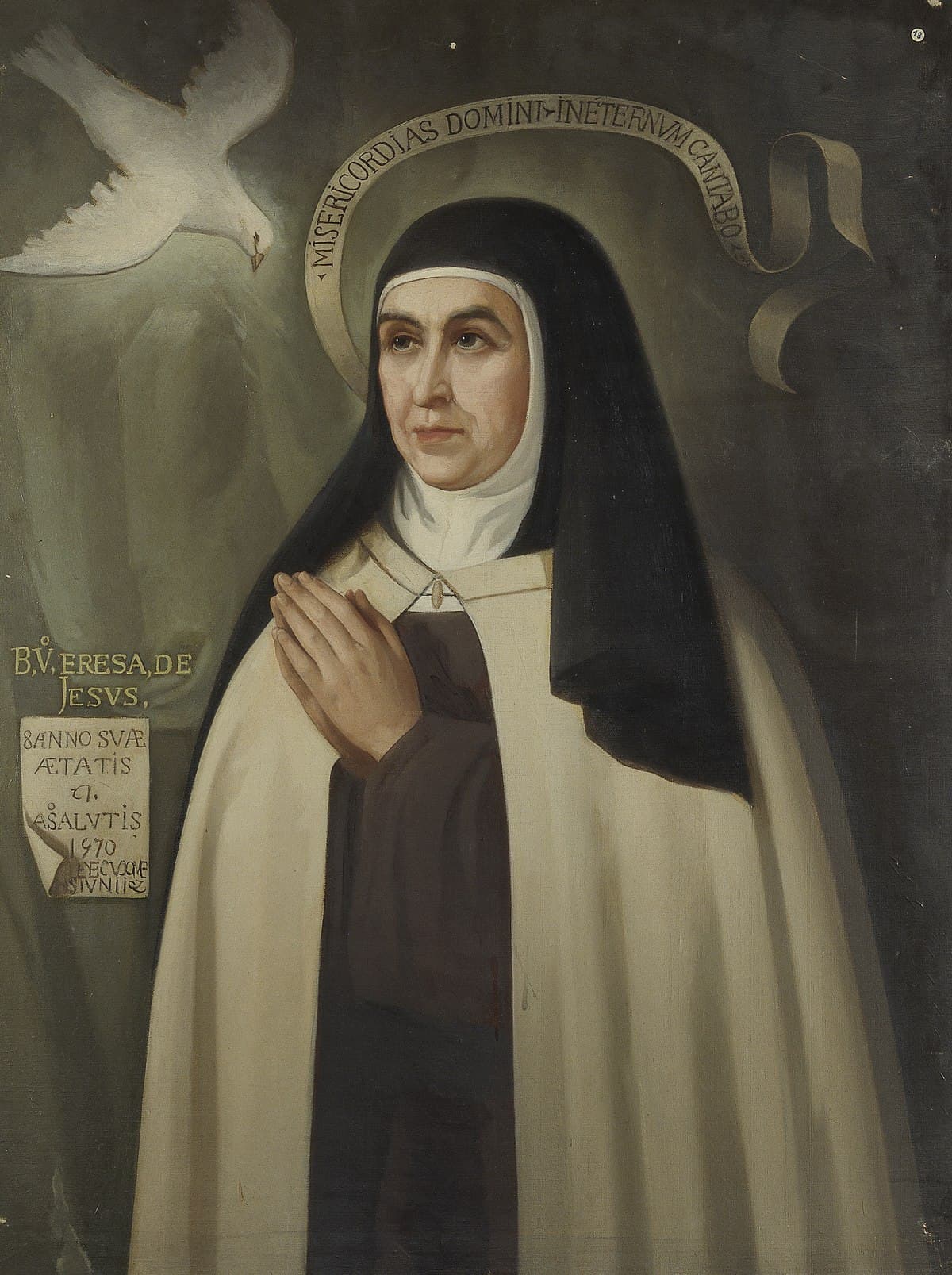
St. Teresa
of Ávila: The Woman Who Reformed a Religious Order at 45
1515 – 1582
“Let nothing disturb you, let nothing frighten you; all things are passing away: God never changes.”
Santa Teresa de Jesús, painting by Eduardo Balaca, c. 1877, Museo del Prado · Public Domain (PD-old-100-expired)
Why She Matters
Teresa reformed a religious order, wrote spiritual classics still read five centuries later, and was declared a Doctor of the Church for her teaching on prayer — all while facing repeated opposition from within her own Church. She matters because she shows that deep, honest prayer is available to anyone willing to be that patient and that persistent.
Virtue for Today
Perseverance in Prayer
Try Today
Spend five unhurried, undistracted minutes in silent prayer today.
The Late Reformer
Teresa of Ávila was in her early forties, chronically ill, and two decades into an undistinguished life as a Carmelite nun when the mystical experiences began that changed everything. She had entered the Monastery of the Incarnation in Ávila at twenty, and by her own frank account in her autobiography Life, had spent years as a proficient performer of religious routine — a woman who prayed without full surrender, who received visitors freely, who had not yet given her will entirely to God.
Then, in 1554, she stood before a statue of the suffering Christ and broke. What followed was not sentiment but conversion: she began to pray differently, to understand differently, and within eleven years, to act differently. In 1562, at age forty-seven, she founded the first reformed Carmelite convent — St. Joseph's in Ávila — with thirteen nuns and the strictest poverty she could negotiate with church authorities.
Why the Reform Mattered
The sixteenth-century Carmelite order had drifted far from its contemplative origins. The Monastery of the Incarnation housed over 180 women, many of whom had entered because their families had no other use for them. Social rank governed daily life: wealthy nuns had private rooms; poor nuns shared dormitories. Visitors came and went freely. Prayer was fitful.
Teresa's reform restored enclosure, common life, and contemplative silence. She insisted on intellectual seriousness in her spiritual directors — her circle included the theologians Francisco de Osuna and Pedro de Alcántara, and she later collaborated with John of the Cross to extend the reform to male Carmelites. By her death in 1582, she had founded seventeen reformed convents, accomplished while chronically ill, financially precarious, and under periodic suspicion from the Inquisition.
On September 27, 1970, Pope Paul VI declared her a Doctor of the Church — the first woman to receive that title, alongside Catherine of Siena. The declaration was not honorific. Her writings were recognized as contributing genuine theological knowledge to the Church's understanding of contemplative prayer, a judgment the USCCB echoes in its feast-day entry for October 15 (USCCB: St. Teresa of Ávila).
The Interior Castle: A Map of the Soul
In 1577, under obedience to her confessor, Teresa wrote The Interior Castle (El Castillo Interior) in a matter of months. It remains among the most systematic accounts of Christian mystical development ever produced.
The central image is the soul understood as a castle of many mansions, made of diamond or very clear crystal, with God dwelling at its center. The soul's journey inward moves through seven dwelling places:
- Mansions 1–3 address the soul's initial turning toward God — self-knowledge, the struggle against attachment, and the development of a disciplined prayer life under the soul's own effort.
- Mansions 4–5 cross the threshold into infused contemplation — prayer that is given rather than generated, where God begins to act in the soul directly and the soul learns to receive rather than produce.
- Mansions 6–7 describe transforming union — spiritual betrothal and finally spiritual marriage, the full integration of the soul's will with God's.
Teresa is careful to warn that the journey is neither linear nor guaranteed. Most souls, she believed, never pass the third mansion — not from lack of desire, but from unwillingness to release control. As Rowan Williams argues in Teresa of Avila (Continuum, 1991), what distinguished her teaching was the insistence that contemplation is not a spiritual achievement but a gift received by those who have emptied themselves of self-sufficiency.
The Woman Behind the Mysticism
Teresa resists reduction to her mysticism. She was practical, decisive, funny, and often exasperated. She traveled by mule-cart across scorching Castilian summers to found convents. She managed cantankerous donors and suspicious bishops. She reportedly told God during one particularly wretched journey: "If this is how you treat your friends, no wonder you have so few."
She was also a woman who had to construct her authority in a world that did not extend it to women — doing so through obedience, through humor, and through the undeniable weight of her lived experience of God.
Helper
Reflection Questions:
- Teresa spent two decades in spiritual lukewarmness before her decisive conversion. What does her trajectory suggest about God's patience — and your own?
- In which of the seven mansions would you honestly locate your current prayer life, and what would genuine movement deeper require of you?
- She reformed an institution from within, at significant personal cost. Where in your own community do you sense a call to reform, and what holds you back from acting on it?
- She was declared Doctor of the Church nearly four centuries after her death. What work in your life may take longer than your lifetime to bear fruit?
- She taught that releasing control is the condition for receiving God fully. What specific area of your life remains firmly in your own grip?
Short Prayer
“Let nothing disturb you, let nothing frighten you; all things are passing away: God never changes. Patience obtains all things. Whoever has God lacks nothing; God alone suffices.”
Prayer to St. Teresa of Ávila
Prayer to St. Teresa of Ávila St. Teresa of Ávila, you sought God through decades of prayer that were often dry, difficult, and met with suspicion from those around you, yet you never stopped seeking, and you taught the whole Church how to pray more honestly because of it. Pray for us when our own prayer feels empty or distracted, that we might have your patience and your trust that God is present even when we cannot feel it. Obtain for us the perseverance to keep returning to prayer, day after day, until it becomes what you called it: a friendship, often held alone, with the One who loves us. St. Teresa, pray for us. Amen.
Source
USCCB
Grow closer to God.
Agnioz is here to walk with you.
Register for FREE and unlock more Catholic content, prayers, and reflections to help you become a more enlightened Catholic — FREE FOREVER.


Let's grow together in faith, hope, and love. 🙏