
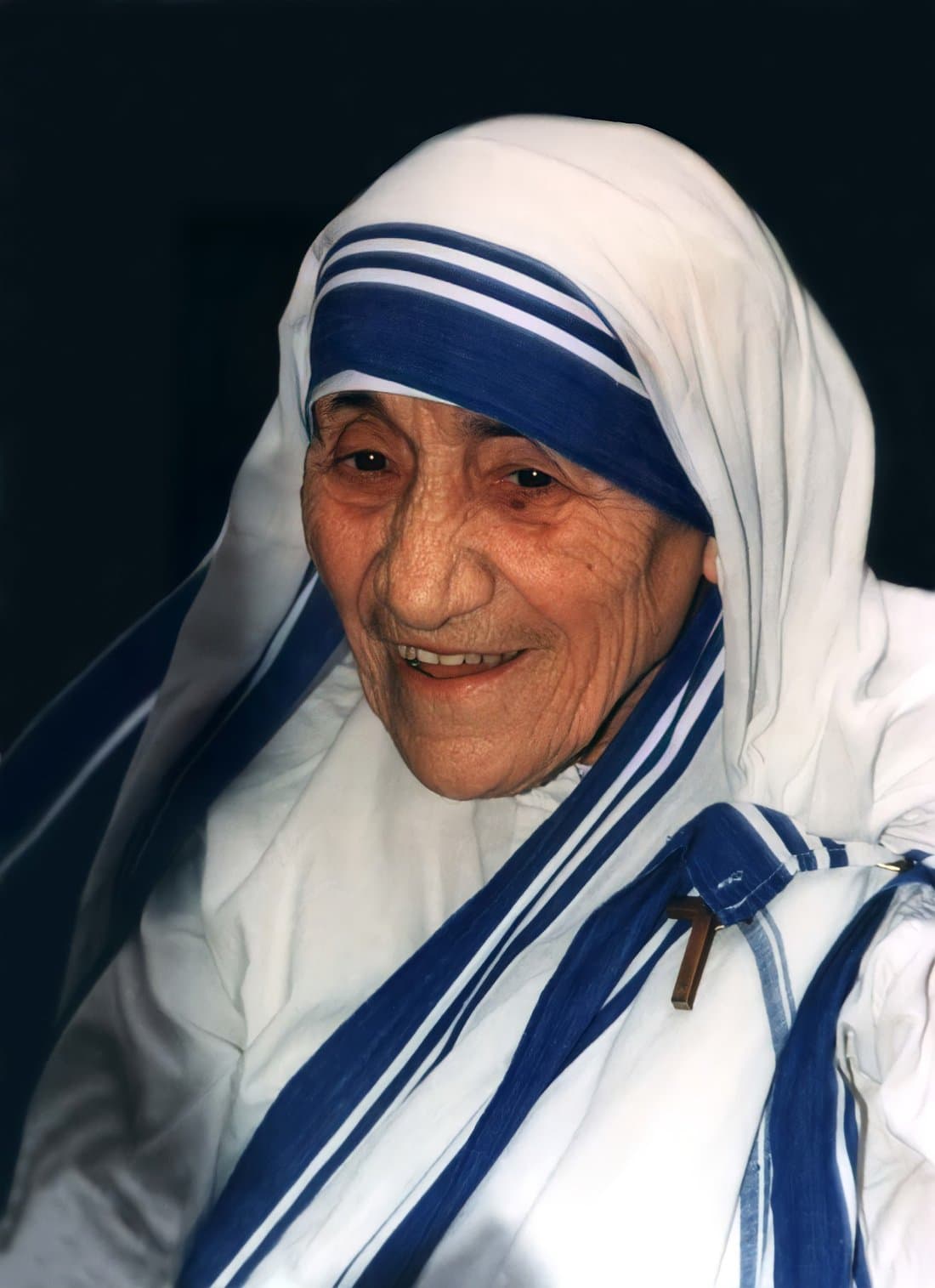
St. Teresa
of Calcutta: Faith in the Dark, Love Among the Poorest
1910 – 1997
“We can do no great things, only small things with great love.”
Mother Teresa, photo by Kingkongphoto & www.celebrity-photos.com, 1995 · CC BY-SA 2.0
Why She Matters
She shows that heroic charity and heroic faith can both be real even when a person feels no spiritual consolation at all, which is exactly the condition many ordinary believers quietly live in.
Virtue for Today
Charity toward the poorest and most overlooked, sustained by hope rather than by felt religious experience.
Try Today
Do one small, hidden act of kindness today for someone easy to overlook — a lonely coworker, an elderly neighbor, someone serving you in a shop — without expecting thanks or recognition.
Anjezë Gonxhe Bojaxhiu was born in 1910 in Skopje, in what was then the Ottoman Empire, the youngest child of Albanian parents whose home was known for its open door to beggars. Her father died when she was eight, likely poisoned for his involvement in Albanian nationalist politics, and the family fell into hardship her mother met with quiet, relentless generosity — a lesson the daughter never forgot. By eighteen, drawn to stories of missionaries serving in Bengal, Gonxhe left home for the Sisters of Loreto in Ireland, learned English, and within weeks sailed for India. She would never see her mother or sister again.
A Comfortable Convent, A Persistent Ache
For nearly two decades, Sister Mary Teresa — the name she took in religion, after St. Thérèse of Lisieux — lived an ordinary, useful religious life, teaching geography and catechism at St. Mary's, a Loreto school for girls of Calcutta's middle class. She was good at it. She became the school's principal. From the convent windows, though, she could see the Motijheel slum pressing against the walls, and on her walks she stepped over the bodies of people who had died in the street overnight because no one else would move them.
On September 10, 1946, riding a train to Darjeeling for her annual retreat, something in her broke open. She would later describe it only briefly and reluctantly: a clear inner conviction that she was to leave the convent and live among the poorest of the poor, serving Christ in the "distressing disguise" of their suffering. She called it her "call within a call" — not a rejection of her vocation as a religious sister, but a demand that it go somewhere entirely new. It took nearly two years of prayer, medical training, and Vatican permission before she was allowed to leave Loreto and step, alone, into the streets of Calcutta wearing a plain white sari with three blue stripes — the sari a poor Bengali woman might wear, chosen deliberately so she would not stand apart from those she served.
Founding the Missionaries of Charity
She began with nothing: no income, no house, no companions, and only a basic course in nursing behind her. She opened a school under a tree for slum children who had never held a pencil. Former students and admirers slowly joined her, and in 1950 Rome approved her small community as a new religious order, the Missionaries of Charity, whose members took a fourth vow beyond poverty, chastity, and obedience — a vow of "wholehearted free service to the poorest of the poor."
Two years later she opened Nirmal Hriday, the Home for the Dying, in a building the city gave her that had once been a Hindu temple's rest house. There she and her sisters gathered people from gutters and railway platforms — not to cure them, most of the time, since many were beyond curing — but to make sure that whoever had lived unnoticed would not die unnoticed and unloved. "A beautiful death," she said, "is for people who lived like animals to die like angels — loved and wanted." Homes for abandoned children, lepers, and later people dying of AIDS followed in city after city. By the time of her death the Missionaries of Charity numbered in the thousands, serving in more than a hundred countries.
The World's Most Famous Nun
Fame arrived whether she wanted it or not. A 1969 BBC documentary and a bestselling book made "Mother Teresa" a household name across the West; she was received by presidents and popes, and in 1979 was awarded the Nobel Peace Prize, which she accepted only on the condition that the customary celebratory banquet be canceled and its cost given to the poor instead. She used the platform bluntly, telling the assembled dignitaries in Oslo that the greatest destroyer of peace in the modern world was abortion, and that the poor were not a problem to be solved but people to be loved.
Critics accused her of romanticizing suffering, of running clinics too poor and too Catholic for secular tastes. She answered less with argument than with the same unglamorous work, decade after decade, in the same slums she had never really left.
Fifty Years in the Dark
The deepest surprise about Mother Teresa did not become public until years after her death. In letters she asked her confessors to destroy — instructions they disobeyed, believing the letters belonged to the Church — she described a spiritual darkness that descended not long after her call within a call and never fully lifted for the rest of her life: an inability to feel God's presence at all, even in prayer, even in the Eucharist, alongside a private terror that she had been abandoned or was even, as she once wrote, "not wanted by God." "The smile," she once told a confessor, "is a mask." She kept ministering, kept smiling for the cameras, kept founding new houses of mercy — while privately experiencing, almost without relief, what mystics call the dark night of the soul.
Rather than a scandal, the Church has come to read this as the deepest evidence of her sanctity: she went on loving and serving with no felt consolation whatsoever, choosing fidelity when faith gave her nothing back that she could feel. She died on September 5, 1997, was beatified in 2003, and was canonized by Pope Francis on September 4, 2016 — with her memorial fixed, by long custom, on the date of her death rather than her canonization.
Helper
Reflection Questions:
- Mother Teresa said "we can do no great things, only small things with great love." What is one small, unglamorous act of love you could offer today to someone easily overlooked?
- She kept serving faithfully through decades of feeling nothing from God in prayer. What helps you keep showing up in faith or duty when you don't feel especially close to God?
- She chose to wear the same simple sari as the poor she served rather than a habit that set her apart. Where in your own life could you choose closeness over comfort or status?
- Her "call within a call" reshaped an already good and settled life. Has God ever unsettled a comfortable plan of yours to ask something more specific of you?
- She insisted the poor were "people to be loved," not "a problem to be solved." How does that distinction change the way you might treat someone in need this week?
Short Prayer
“Mother Teresa, you loved Christ in those the world walked past. Teach me to see the person in front of me today as you saw them — worth stopping for, worth loving, however small the gesture. Amen.”
Prayer to St. Teresa of Calcutta
St. Teresa of Calcutta, you left the safety of a settled vocation to answer a call you could not fully explain, and you spent yourself for fifty years among the dying and forgotten of Calcutta's streets. You did this not on a tide of constant spiritual comfort but often in darkness, feeling little or nothing of God's presence, and yet you never stopped believing or serving. Teach me that love is proven in action, not in feeling. When my own faith feels dry or my prayers feel unheard, help me to keep showing up anyway, in small faithful acts, trusting that God is present even when I cannot sense Him. Give me your eyes to see Christ in the person society overlooks, and your courage to serve without needing applause or certainty. Pray for me, that I may do small things with great love, today and every day. Amen.
Grow closer to God.
Agnioz is here to walk with you.
Register for FREE and unlock more Catholic content, prayers, and reflections to help you become a more enlightened Catholic — FREE FOREVER.


Let's grow together in faith, hope, and love. 🙏