St. Thomas Aquinas: The Genius Who Called His Own Work Straw
1225 – 1274
“All that I have written seems to me like so much straw compared to what I have seen and what has been revealed to me.”
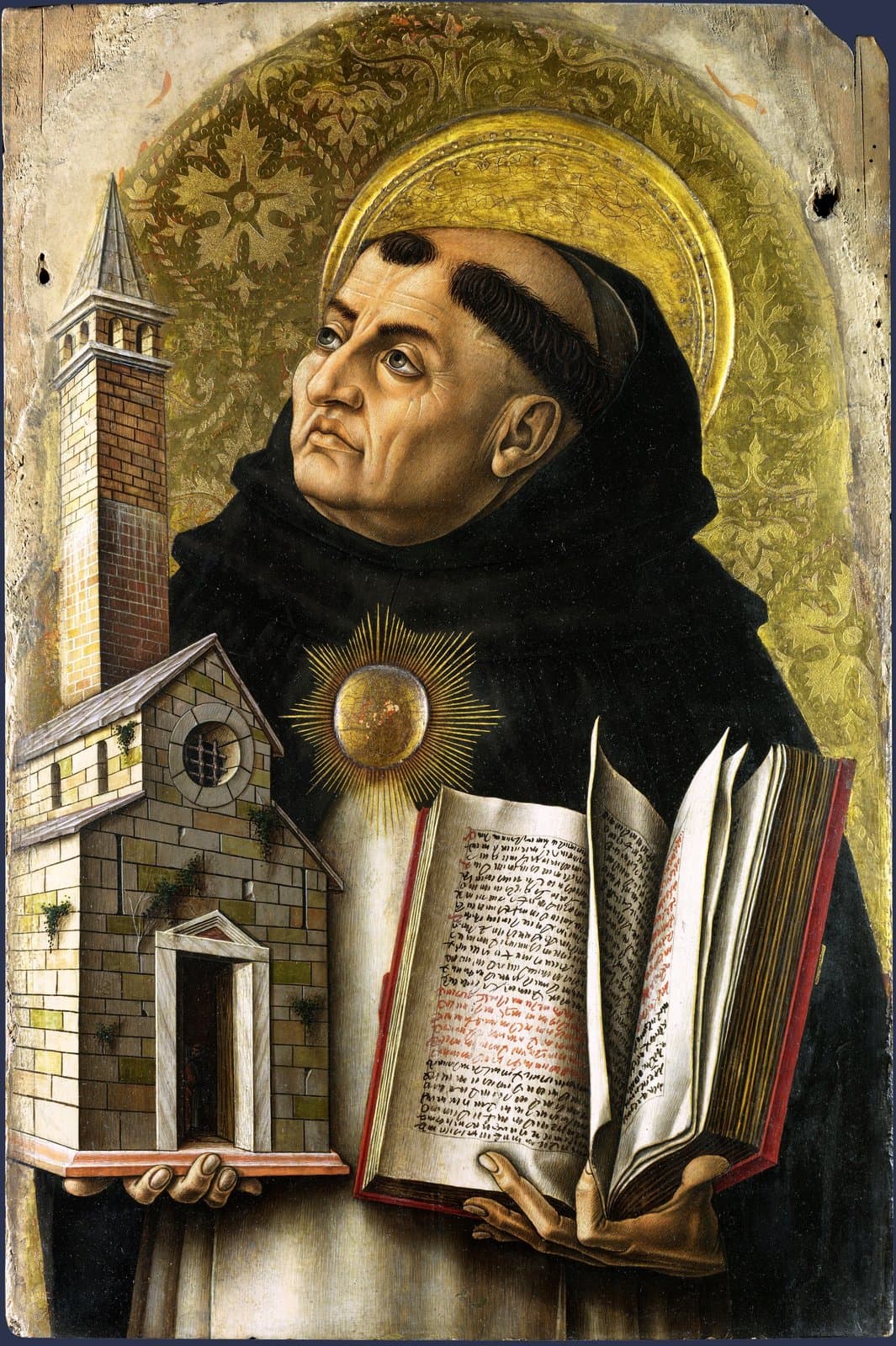
Saint Thomas Aquinas, painting by Carlo Crivelli, 1476 · Public Domain
Why He Matters
Aquinas produced the single most influential systematic work of Catholic theology in history, showing that rigorous reason and deep faith are not opposed but can serve each other. He matters because he modeled taking both the intellect and the mystery of God seriously, and then, at the end, humbly recognized the limits of even his greatest work before the reality of God himself.
Virtue for Today
Intellectual Humility
Try Today
Spend ten quiet minutes today present to the God your reasoning can point toward but never fully contain.
Locked in a Tower for His Vocation
Thomas was born around 1225 into a noble Italian family near Aquino, related to both the Holy Roman Emperor and the King of France. His family expected him to become a Benedictine abbot, a respectable and comfortable path to influence, and sent him to study at the great monastery of Monte Cassino as a boy. Instead, as a young man studying at the University of Naples, Thomas encountered the Dominicans, a newer order of mendicant friars committed to poverty, preaching, and study, and decided to join them — a decision his family found so unacceptable that his own brothers intercepted him on the road and imprisoned him in the family castle for over a year, reportedly even sending a woman to tempt him from his vocation. Thomas refused to budge, and his family eventually relented.
A Silent Student Nicknamed "The Dumb Ox"
Thomas studied under the great Dominican theologian Albert the Great, first in Paris and then in Cologne. He was famously large, quiet, and slow to speak in class, which led classmates to nickname him "the dumb ox" — until Albert, recognizing the depth beneath the silence, reportedly told the other students that this "ox" would one day bellow so loud his voice would fill the world. Thomas went on to earn his doctorate in theology at the University of Paris and spent much of the rest of his life teaching, writing, and defending the mendicant orders against critics who questioned their legitimacy within the university.
The Summa Theologiae
Thomas's central and most influential achievement was the Summa Theologiae, an enormous, systematically organized work attempting to lay out the whole of Christian theology using the tools of careful philosophical reasoning, especially drawing on the recently rediscovered works of Aristotle. Rather than simply asserting doctrine, Thomas's method presents the strongest objections to a position before answering them point by point — a structure that models patient, honest engagement with difficult questions rather than dismissing them. The Summa became, and remains, one of the most studied works in the history of Catholic theology and philosophy, foundational to what is now called Thomism.
"It All Seems Like Straw"
On December 6, 1273, while celebrating Mass, Thomas experienced something that affected him so profoundly that he stopped writing altogether, leaving the Summa unfinished. When his secretary and close companion, Reginald of Piperno, urged him to return to his great work, Thomas answered that he could write no more, because compared to what had been revealed to him, everything he had written now seemed like straw. He never explained in detail what he had experienced, and he died a few months later, in March 1274, on his way to a Church council. The Church has never read his remark as a repudiation of his own theology — Thomas was canonized in 1323 and later declared a Doctor of the Church, with his thought recommended especially strongly by later popes as a model for Catholic philosophy and theology.
Helper
Reflection Questions:
- Thomas's own family tried to force him away from the vocation he was certain of. Have you ever had to hold firm to a calling that people close to you didn't understand or support?
- He was mocked as slow and dull by classmates who couldn't see what was underneath his silence. Where have you misjudged someone — or been misjudged yourself — based on a first impression?
- His theological method took the strongest arguments against his own positions seriously before answering them. How honestly do you engage with views you disagree with, rather than dismissing them quickly?
- After a profound encounter with God, all his brilliant writing suddenly felt small to him by comparison. What accomplishment of yours might look different in the light of a real encounter with God?
- Thomas spent his whole intellectual life trying to understand God more clearly through careful reasoning. Do you bring your whole mind, not just your feelings, into your relationship with God?
Short Prayer
“St. Thomas Aquinas, pray for us — that we may seek truth honestly with our whole minds, and hold our own achievements humbly before God. Amen.”
Prayer to St. Thomas Aquinas
Prayer to St. Thomas Aquinas St. Thomas Aquinas, you gave your life to the patient, disciplined pursuit of truth, taking even the strongest objections to the faith seriously rather than brushing them aside, and you left behind a body of theology that has shaped the Church for over seven centuries. And yet at the end, after a single encounter with God, you called all of it straw. Pray for us in our own study and our own accomplishments, that we might pursue truth as rigorously as you did, and hold what we achieve as humbly as you did when you finally saw it beside the reality of God himself. Help us love God with our whole minds, not only our feelings. St. Thomas Aquinas, pray for us. Amen.
Catholic Answers — "When St. Thomas Aquinas Likened His Work to Straw, Was That a Retraction of What He Wrote?"
Grow closer to God.
Agnioz is here to walk with you.
Register for FREE and unlock more Catholic content, prayers, and reflections to help you become a more enlightened Catholic — FREE FOREVER.


Let's grow together in faith, hope, and love. 🙏