St. Thomas More: The Lord Chancellor Who Would Not Bend
1478 – 1535
“I die the King's good servant, but God's first.”
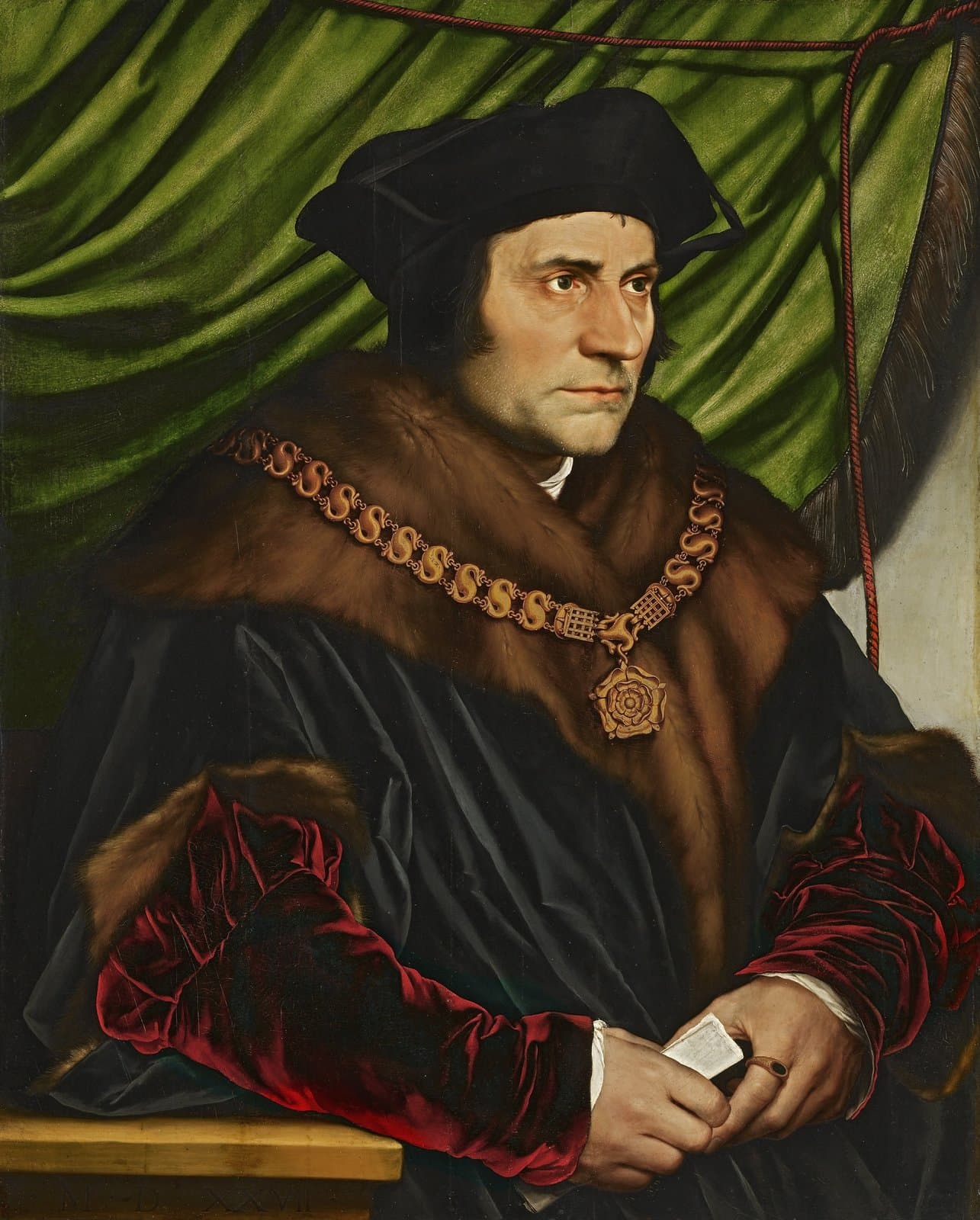
Portrait of Sir Thomas More, painting by Hans Holbein the Younger, 1527, The Frick Collection · Public Domain
Why He Matters
Thomas More shows that genuine loyalty to legitimate authority and ultimate loyalty to conscience are not automatically the same thing, and that a person of real power and privilege can still choose to lose everything rather than violate what he believes to be true.
Virtue for Today
Integrity of Conscience
Try Today
Identify one place where social or professional pressure quietly shapes what you say, and say the truer thing instead, at whatever small cost.
A Renowned Statesman and Scholar
Thomas More was born in London on February 7, 1478, the son of a prominent judge. He trained in law, but was also one of the leading humanist scholars of his generation, a close friend and correspondent of Erasmus, and the author of Utopia (1516), an inventive and still-studied work of political imagination. He combined this intellectual life with a demanding career in royal service, rising steadily through a series of government posts under King Henry VIII, including Speaker of the House of Commons, before reaching the kingdom's highest legal office, Lord Chancellor, in 1529 — the first layman ever to hold that position.
The King's Great Matter
More's downfall began with what came to be called "the King's Great Matter": Henry VIII's demand to annul his marriage to Catherine of Aragon so he could marry Anne Boleyn, a demand the pope refused to grant. When Henry responded by breaking with Rome and declaring himself Supreme Head of the Church of England, More — a devout and theologically serious Catholic — found his conscience directly opposed to his king's central political project. In 1532, rather than support the divorce or the break with Rome, More resigned as Lord Chancellor, retreating from public life and, as much as possible, from public comment.
Silence as Its Own Defense
More understood the legal danger he was in, and his strategy afterward was to say as little as possible — under English law of the time, silence could not, in principle, be treated as an admission of treason. He refused to attend Anne Boleyn's coronation and refused to sign the Act of Succession, which required an oath acknowledging the annulment and Henry's new marriage, but he also refused to publicly explain why, hoping his silence would protect both his family and himself. It did not. He was arrested in April 1534 and imprisoned in the Tower of London for fifteen months.
Trial and Condemnation
More was finally brought to trial in July 1535 on a charge of treason, based chiefly on the perjured testimony of Richard Rich, a former acquaintance who claimed More had privately denied the king's supremacy over the Church in conversation. Once formally condemned, More at last spoke openly, declaring that no temporal ruler could be head of the Church, and defending the unity of the Western Church under the papacy as something no single kingdom had the right to unilaterally break.
Execution
Thomas More was beheaded on Tower Hill on July 6, 1535. According to his son-in-law and first biographer, William Roper, who was present in the household throughout these events, More's last words to the crowd were: "I die the King's good servant, but God's first" — a single sentence that captured the entire shape of his final years: not a rejection of loyal service to the crown, but an insistence that loyalty to conscience and to God had to come before it. He was canonized in 1935, four hundred years after his death, alongside St. John Fisher, the only bishop to share his refusal.
Helper
Reflection Questions:
- More resigned a position of enormous power and influence rather than support something he believed was wrong. What position, comfort, or status might you need to be willing to give up for the sake of your own conscience?
- He tried to protect himself and his family through careful silence rather than direct confrontation, for as long as that was possible. Is there wisdom, sometimes, in choosing your moment rather than speaking immediately?
- He was ultimately condemned on testimony many believed to be false or exaggerated. How do you respond when you are treated unjustly by a system that is supposed to be fair?
- More's famous last words balanced loyalty to legitimate authority with a higher loyalty to God, rather than rejecting authority altogether. Where in your own life do you need to hold two loyalties in the right order, rather than discarding one entirely?
- He spent fifteen months in prison before his trial, with real uncertainty about his fate the entire time. How do you sustain hope and integrity during a long period of uncertainty rather than a single dramatic moment?
Short Prayer
“St. Thomas More, pray for us — that we may serve rightful authority faithfully, but never above our conscience or our God. Amen.”
Prayer to St. Thomas More
Prayer to St. Thomas More St. Thomas More, you rose to the highest office a layman could hold in your kingdom, and you gave it up, and finally your life, rather than say something you did not believe to be true. You tried every reasonable, careful way to protect your family and yourself before that became impossible, and even then you went to your death without bitterness toward the king you had served so faithfully. Pray for us in the moments, large and small, where honesty costs us standing, comfort, or approval. Give us the patience you showed in silence and the courage you showed when silence was no longer possible. St. Thomas More, pray for us. Amen.
William Roper, "The Life of Sir Thomas More" (c. 1556); EWTN — "St. Thomas More Was the King's Good Servant, But God's First"; Britannica — "Sir Thomas More"
Grow closer to God.
Agnioz is here to walk with you.
Register for FREE and unlock more Catholic content, prayers, and reflections to help you become a more enlightened Catholic — FREE FOREVER.


Let's grow together in faith, hope, and love. 🙏