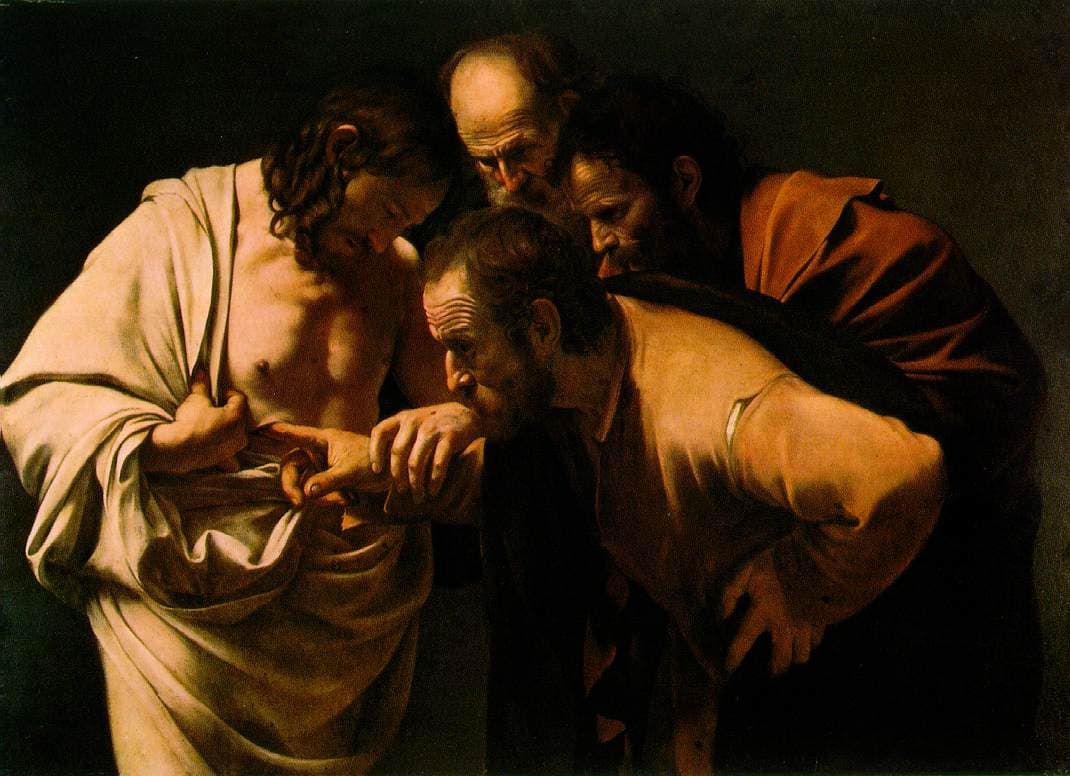
The Incredulity of Saint Thomas, painting by Caravaggio, c. 1600–1601 · Public Domain
Why He Matters
Thomas shows that honest doubt, brought directly to Christ rather than suppressed or hidden, can become the very occasion of the deepest faith, a real comfort to anyone who struggles to believe without seeing.
Virtue for Today
Doubt Becoming Faith
Try Today
Name one doubt or question about your faith honestly in prayer today, instead of setting it aside unexamined.
The Twin Among the Twelve
Thomas appears in all four Gospel lists of the Twelve Apostles, called "Didymus" in the Gospel of John, a Greek word meaning "twin" (his Aramaic name, Thomas, means the same thing). Beyond his name and calling, the Synoptic Gospels tell us almost nothing about him individually; what we know of his personality comes almost entirely from three episodes recorded in the Gospel of John.
Willing to Die With Him
The first glimpse of Thomas's character comes in John 11, when Jesus proposes returning to Judea, where his enemies had recently tried to stone him, in order to raise Lazarus from the dead. The other disciples hesitate, but Thomas says to them, "Let us also go, that we may die with him" (John 11:16) — a statement of blunt, fatalistic loyalty from a man willing to face death alongside Jesus even without understanding what Jesus was about to do. At the Last Supper, it is Thomas who interrupts Jesus's discourse to ask the practical question, "Lord, we know not whither thou goest; and how can we know the way?" (John 14:5), prompting Jesus's answer, "I am the way, and the truth, and the life."
"Unless I Shall See"
Thomas earned his lasting nickname from the episode in John 20. He was not present when the risen Jesus first appeared to the other ten apostles on Easter evening, and when they told him, "We have seen the Lord," he refused to take their word for it: "Except I shall see in his hands the print of the nails, and put my finger into the place of the nails, and put my hand into his side, I will not believe" (John 20:25). A week later, Jesus appeared again, this time with Thomas present, and invited him specifically to do exactly what he had demanded — touch the wounds. John's Gospel does not say whether Thomas actually touched him; what it records instead is Thomas's immediate response: "My Lord and my God" (John 20:28), the most direct, explicit declaration of Jesus's divinity spoken by anyone to his face anywhere in the four Gospels. Jesus's reply, "because thou hast seen me, thou hast believed: blessed are they that have not seen, and have believed," has been understood by the Church ever since as addressed as much to every later believer as to Thomas himself.
Mission to India
The New Testament says nothing about what became of Thomas afterward, but a strong and very old tradition, especially preserved among the Saint Thomas Christians of Kerala in southern India, holds that Thomas carried the Gospel to Parthia (modern Iran) and then to India, arriving at the port of Muziris on the Malabar coast around A.D. 52. Tradition credits him with founding seven churches in Kerala and eventually being martyred near Mylapore, close to modern Chennai, killed by a spear thrust while at prayer, around A.D. 72. While the fullest surviving accounts of this mission come from later apocryphal literature (the Acts of Thomas) whose details historians treat cautiously, the Saint Thomas Christian community's own continuous, ancient self-identification as founded by the apostle is treated by most scholars as carrying real historical weight, even where individual miracle stories cannot be verified. His traditional tomb is venerated today at the San Thome Basilica in Chennai, one of only three churches in the world built over the tomb of an apostle.
Patron of Doubters
Thomas's feast, celebrated July 3, has made him, somewhat ironically, the patron most often invoked by people struggling with religious doubt — not because doubt itself is virtuous, but because Christ's response to him shows that honest, searching doubt met honestly by Christ can become, not the opposite of faith, but its occasion.
Helper
Reflection Questions:
- Thomas refused to believe secondhand testimony and insisted on his own encounter with Christ. Is there a part of your faith you have never really tested or made your own, only accepted because others told you to?
- Jesus did not rebuke Thomas for doubting; he met him in the specific place of his doubt. Where do you need Christ to meet you honestly, rather than pretending a struggle isn't there?
- Thomas moved from "I will not believe" to "My Lord and my God" within one encounter. Has an honest confrontation with truth ever changed you that quickly, or are you more often a slow, gradual believer — and is that all right?
- Tradition holds that Thomas carried the Gospel farther than almost any other apostle, to a land Rome barely knew. What is the farthest, most unlikely place — geographically or relationally — God might be asking you to bring your faith?
- Jesus said those who believe without seeing are blessed. What helps you believe today, when you cannot see or touch what you're trusting in?
Short Prayer
“St. Thomas the Apostle, pray for us — that our doubts may lead us, as yours did, to say "My Lord and my God." Amen.”
Prayer to St. Thomas the Apostle
Prayer to St. Thomas the Apostle St. Thomas, you refused to pretend a faith you did not yet have, and when Christ met you honestly in your doubt, you responded with one of the clearest declarations of faith in all the Gospels: my Lord and my God. Pray for us in our own honest doubts and unanswered questions, that we would bring them directly to Christ rather than hiding them out of shame. Help us trust that faith tested honestly, even slowly, can become as strong as yours. St. Thomas the Apostle, pray for us. Amen.
Gospel of John 11:16, 14:5, 20:24-29 (Douay-Rheims); Britannica — "Saint Thomas"
Grow closer to God.
Agnioz is here to walk with you.
Register for FREE and unlock more Catholic content, prayers, and reflections to help you become a more enlightened Catholic — FREE FOREVER.


Let's grow together in faith, hope, and love. 🙏