
St. Valentine: The Martyr Behind the Holiday
? – 269
“"Romae, via Flaminia, natalis beati Valentini, Presbyteri et Martyris" — "At Rome, on the Flaminian Way, the birthday into heaven of blessed Valentine, priest and martyr" (his entry in the Roman Martyrology; no first-person quotation from him survives)”
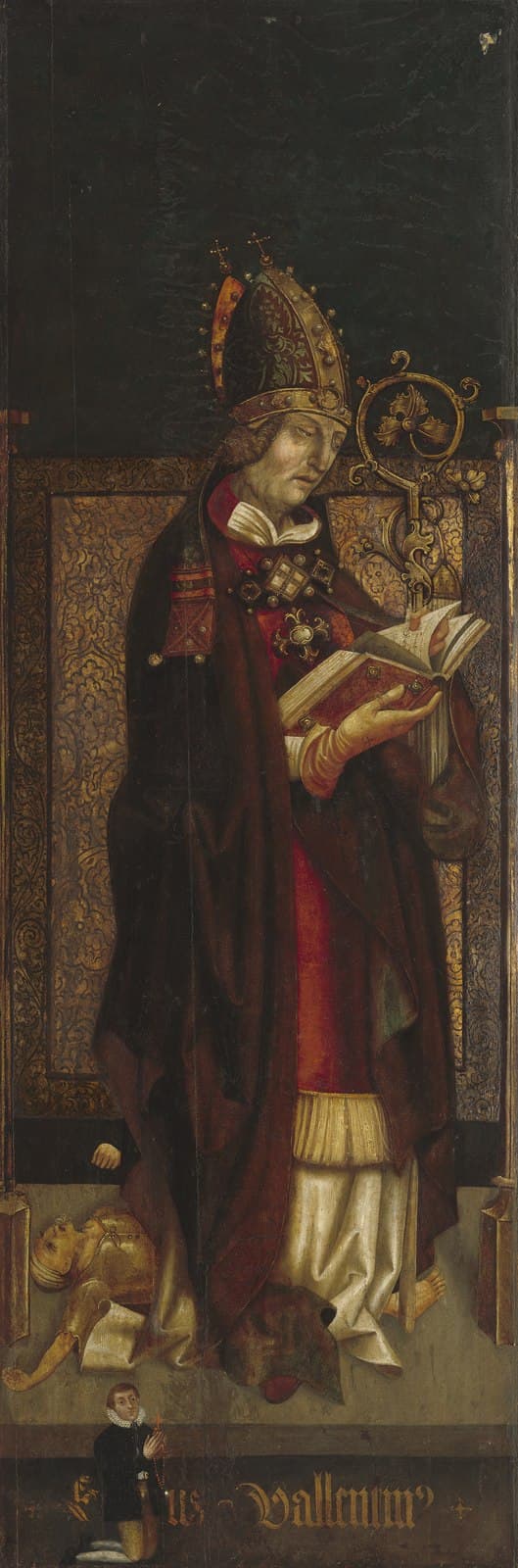
Saint Valentine, panel painting, Tyrolean School, c. 1500–1525, National Gallery of Art, Washington · CC0 (National Gallery of Art Open Access)
Why He Matters
Valentine shows how easily a documented but thin early martyrdom can be overtaken, centuries later, by an entirely unrelated popular tradition — and invites a costlier, more self-giving understanding of love than the holiday built on his name usually offers.
Virtue for Today
Costly Love
Try Today
Do one deliberate, sacrificial act of love today for someone who is not a romantic partner, a family member, a struggling friend, a stranger in need, modeled on love that costs something rather than love that is only sentimental.
More Than One Valentine
The Catholic Encyclopedia is unusually direct about St. Valentine: at least three different martyrs by that name were commemorated on February 14 in early Christian records, and it is not settled which, if any, is the "real" Valentine behind the later legend, or whether the popular tradition has simply merged several distinct men into one composite figure. The two most prominent candidates are a priest martyred in Rome and a bishop of Interamna (modern Terni, Italy), both apparently dying in the late third century and both buried along the Flaminian Way north of Rome, though at different sites; a third Valentine is recorded as martyred with companions in Roman North Africa. The Encyclopedia states plainly that whatever Acts survive for these figures are "of relatively late date and of no historical value," meaning the specific stories told about his life and death cannot be treated as reliable history.
What the Archaeology Actually Shows
Despite the thin biographical record, there is genuine physical and historical evidence of an early cult. Pope Julius I, who reigned from 337 to 352, had a basilica built roughly two miles outside Rome over the traditional burial site associated with the Roman priest Valentine, and excavations in later centuries uncovered catacomb burials in the area consistent with early veneration. By the Middle Ages, Rome's Flaminian Gate had become popularly known as the "Gate of St. Valentine" because of a small church dedicated to him nearby. This is enough to confirm that a martyr, or martyrs, by this name were genuinely venerated from an early date, even though the specific narrative of his arrest, trial, and death cannot be independently confirmed.
A Holiday Built From an Unrelated Folk Belief
The romantic associations that make February 14 instantly recognizable worldwide have essentially nothing to do with anything documented about the historical Valentine or Valentines. They trace instead to a widespread medieval folk belief that birds began choosing their mates on February 14, a notion given its most famous literary expression in Geoffrey Chaucer's fourteenth-century poem "Parliament of Fowls." Once that association took hold, the date already carrying Valentine's name from the Church calendar simply absorbed the romantic custom that grew up around it, first as an occasion for exchanging love notes and verses in fourteenth-century France and England, later evolving into the modern commercial holiday. The saint's actual, documented identity, a martyr or martyrs who died for their Christian faith under Roman persecution, has almost nothing in common with the holiday now built on his name.
A Feast Quietly Set Aside
In the Church's 1969 revision of the General Roman Calendar, Valentine's feast was reduced from a universal obligatory observance to an optional, local one, for the same basic reason as several other saints in this collection: an acknowledgment that the historical record supporting his individual biography is too thin and too tangled among multiple figures to sustain a confident universal commemoration. He was never formally removed from the Church's list of saints, but the change reflected an honest reckoning with how little can actually be verified.
Helper
Reflection Questions:
- The romantic meaning of Valentine's Day has almost nothing to do with the documented history of the saint himself. Where else in your life has a popular tradition drifted far from its original, more serious source?
- Whatever the details, the real Valentine or Valentines died for their Christian faith under persecution. How does that fact change, or not change, how you think about the holiday that now carries his name?
- The Church openly acknowledges uncertainty about which Valentine, or how many, actually lie behind the legend. How comfortable are you sitting with real uncertainty in your own faith, rather than needing every detail resolved?
- If Valentine's Day is truly about a martyr's costly love for Christ rather than romance, what would it look like to "celebrate" that meaning concretely today, for someone other than a romantic partner?
- Valentine's feast was quietly downgraded once the Church took a more careful look at the evidence. Is there a belief or assumption in your own life you've never actually examined closely, out of habit rather than conviction?
Short Prayer
“St. Valentine, pray for us — that our love may be as costly and faithful as the love that led you to martyrdom. Amen.”
Prayer to St. Valentine
Prayer to St. Valentine St. Valentine, so little of your actual story survives that even the Church is honest about the uncertainty, yet the fact underneath the uncertainty remains real: you died for love of Christ, at a cost the holiday bearing your name rarely remembers. Pray for us as we navigate love in all its forms, romantic and otherwise, that we would choose love that costs something real rather than love that is only sentiment or obligation. Help us give ourselves as fully to the people who depend on us as you gave yourself to Christ. St. Valentine, martyr, pray for us. Amen.
Catholic Encyclopedia (New Advent) — "St. Valentine"; Roman Martyrology

Grow closer to God.
Agnioz is here to walk with you.
Register for FREE and unlock more Catholic content, prayers, and reflections to help you become a more enlightened Catholic — FREE FOREVER.


Let's grow together in faith, hope, and love. 🙏