
St. Vincent
de Paul: The Peasant Priest Who Reinvented Christian Charity
1581 – 1660
“The poor are your masters, and you are their servants.”
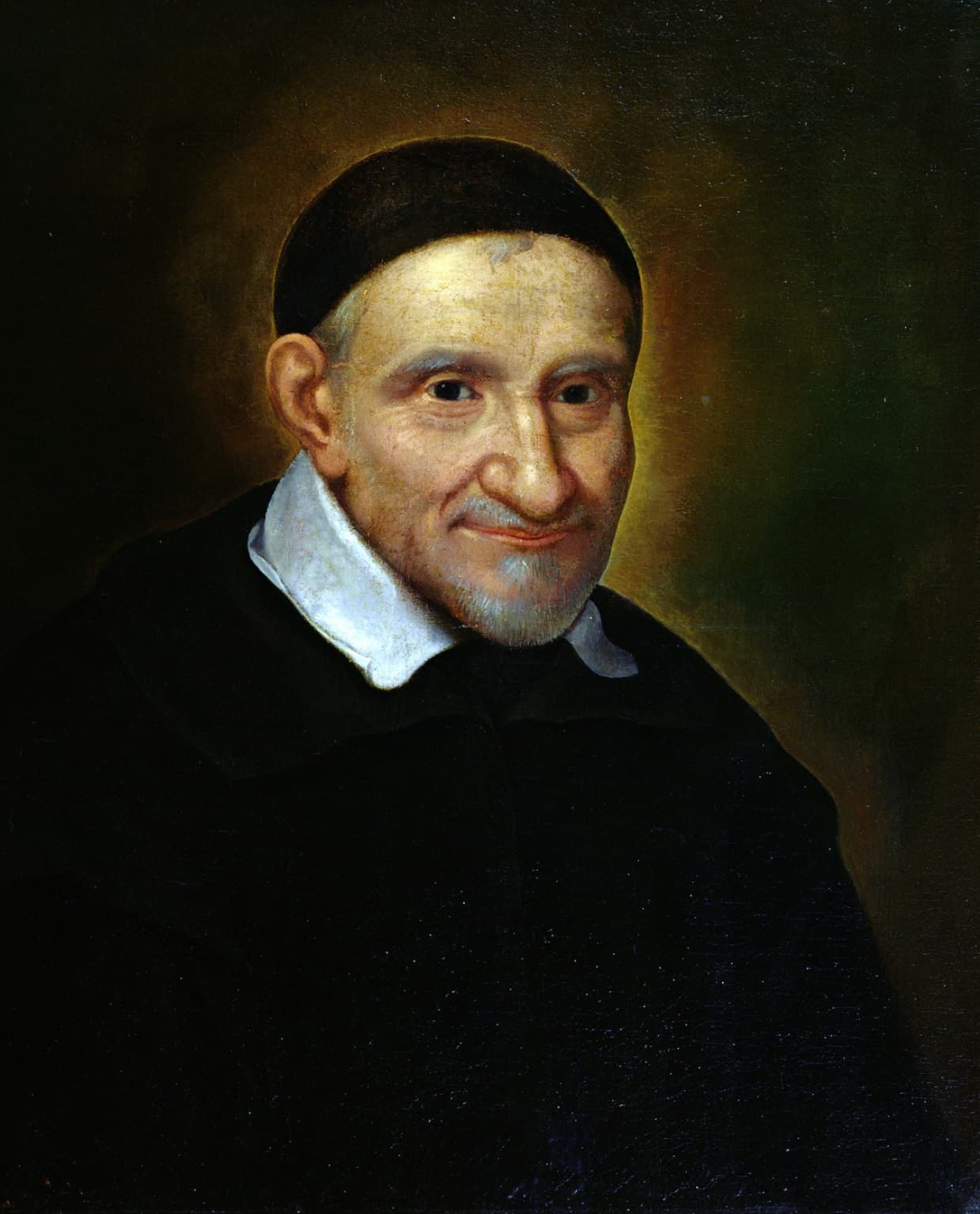
Portrait of St. Vincent de Paul, painting by Simon François de Tours, 17th century · Public Domain
Why He Matters
Vincent moved from a fairly conventional clerical career toward direct service of the rural poor and enslaved galley convicts after two pastoral encounters shook him, eventually founding organizations — the Congregation of the Mission and, with St. Louise de Marillac, the Daughters of Charity — that permanently changed how the Church organizes care for the poor. He matters because he shows that lasting charity usually requires building structures, not just performing individual acts of kindness.
Virtue for Today
Charity
Try Today
Perform one concrete act of direct service today for someone in material need — your time and presence, not only money.
From Peasant Origins to Captivity
Vincent de Paul was born in 1581 in Pouy, a small village in southwestern France, to a peasant farming family — a background he reportedly felt some early embarrassment about before it became central to his later mission. He was ordained a priest in 1600 at the unusually young age of nineteen (with a dispensation for his age), initially pursuing a fairly conventional clerical career focused on securing a comfortable benefice.
According to his own later, somewhat disputed account, around 1605 he was captured by Barbary pirates during a sea voyage and enslaved in Tunis for roughly two years before escaping or being ransomed. Whatever the precise facts of this episode, it marked the beginning of a broader shift in his priorities, which accelerated after two pivotal pastoral experiences: hearing the confession of a dying peasant whose spiritual neglect shocked him, and later ministering to convicted men condemned to row in the king's galleys — among the most brutal conditions in France at the time.
Building Structures That Would Outlast Him
Rather than simply performing individual acts of charity, Vincent increasingly focused on building durable institutions. In 1625 he founded the Congregation of the Mission (commonly called the Vincentians or Lazarists), a community of priests dedicated to evangelizing and serving the rural poor, who at the time were often pastorally neglected compared to wealthier urban parishes.
In 1633, working closely with St. Louise de Marillac, he co-founded the Daughters of Charity — a radical innovation for its era. Existing women's religious orders were cloistered, but the Daughters of Charity were designed to live and work directly among the poor in hospitals, homes, and streets, an "active" religious life outside convent walls that was highly unusual and initially resisted by some Church authorities before becoming a model widely imitated afterward.
A Legacy of Organized Mercy
Vincent organized large-scale relief efforts for regions devastated by the Thirty Years' War, worked to ransom enslaved galley convicts and North African captives, established hospitals and foundling homes for abandoned children, and trained clergy more rigorously in pastoral care of the poor. He died in 1660 and was canonized in 1737. In 1833, more than a century after his death, a group of Parisian students inspired by his example founded the Society of St. Vincent de Paul, a lay charitable organization that remains active in dozens of countries today, still bearing his name and continuing his focus on direct, personal service to those in need.
Helper
Reflection Questions:
- Vincent's turn toward the poor came through direct encounters — a dying peasant, condemned galley slaves — not abstract commitment. When has a specific encounter, rather than an idea, changed your priorities?
- He built lasting institutions rather than relying only on his own personal effort. Where in your life could you build something structural, rather than relying solely on your own energy, to sustain good you care about?
- The Daughters of Charity broke with the norms of religious life in his era to go directly to where the poor actually were. Where might faithfulness require you to work outside familiar or comfortable structures?
- His organization still bears his name and continues his exact mission nearly four centuries later. What are you building or contributing to that could meaningfully outlast you?
- He is said to have felt early embarrassment about his humble origins before making them central to his calling. Is there a part of your own background or story you've been slow to see as a gift rather than a liability?
Short Prayer
“St. Vincent de Paul, pray for us — that we may see and serve Christ in the poor with humility and love. Amen.”
Prayer to St. Vincent de Paul
Prayer to St. Vincent de Paul St. Vincent de Paul, a chance encounter with a dying peasant's confession and later with convicts condemned to the king's galleys turned your priesthood away from comfort and toward the poor, whom you came to call your true masters. You built institutions that outlasted you by centuries, training others to serve directly and personally rather than from a safe distance. Pray for us when charity would be easier as a check we write than a person we sit with, and give us the humility to serve people we might otherwise overlook. Help everything we build in your name outlast our own effort, the way your work still does nearly four centuries later. St. Vincent de Paul, pray for us. Amen.
Vatican.va — Canonization records, 1737; Society of St. Vincent de Paul historical archives

Grow closer to God.
Agnioz is here to walk with you.
Register for FREE and unlock more Catholic content, prayers, and reflections to help you become a more enlightened Catholic — FREE FOREVER.


Let's grow together in faith, hope, and love. 🙏