
St. Zita: Forty-Eight Years
of Faithful Service
1212 – 1272
“A servant is not good if she is not industrious: work-shy piety in people of our position is a sham.”
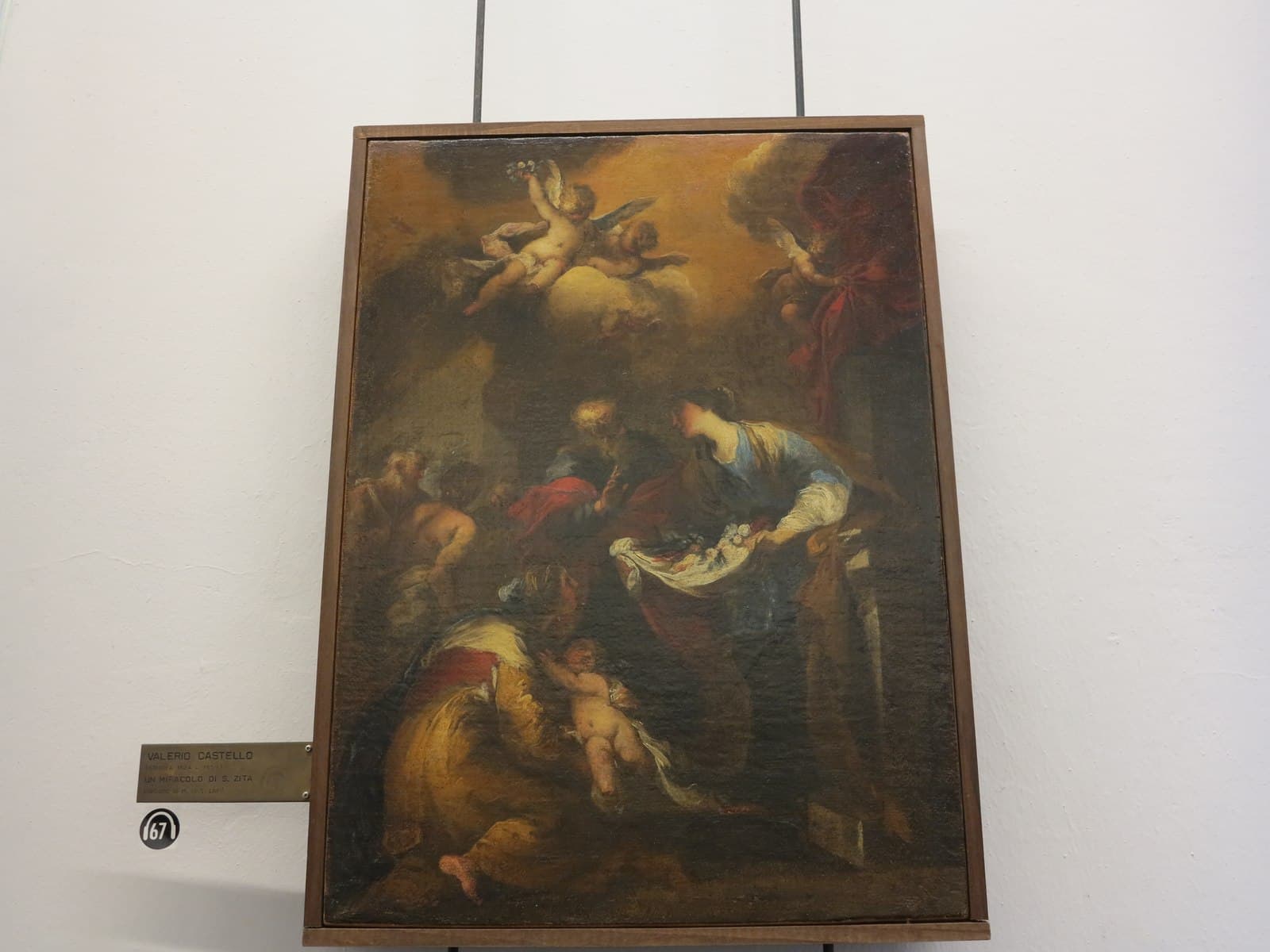
A Miracle of St. Zita, painting by Valerio Castello, 17th century; photograph by Mongolo1984 · CC BY-SA 3.0
Why She Matters
Zita shows that a life of hidden, repetitive domestic labor, offered patiently and generously over decades, can become genuine, widely recognized holiness, without ever requiring public recognition, higher status, or an escape from ordinary duties to prove it.
Virtue for Today
Diligent Service
Try Today
Do one small, unglamorous task today, at home or at work, with full effort and attention, treating it as an offering rather than a chore to get through.
Into Service at Twelve
Zita was born around 1212 to a poor family in Monsagrati, a village near Lucca in Tuscany, Italy, and was raised by a devout mother who taught her to find God's will in ordinary circumstances rather than extraordinary ones. At twelve she was sent into domestic service in the household of the Fatinelli family in Lucca, a wool-merchant family of some means, where she would remain, doing the same kind of hard, repetitive household labor, for the next forty-eight years, until her death.
Hostility Before Acceptance
Zita's early years in the Fatinelli household were not gentle. Contemporary accounts describe her as met with real hostility: harsh treatment, beatings, and open contempt, partly because her intense, disciplined piety, rising before dawn for Mass, fasting, spending her few free hours in prayer, struck her fellow servants as a kind of showy self-righteousness rather than genuine devotion, and partly because the family itself was simply unwelcoming to a new servant girl. Zita did not answer this treatment by becoming resentful or by softening her convictions to fit in more easily; she is remembered instead for absorbing the mistreatment while continuing, quietly and consistently, to work harder and pray more than anyone demanded of her, gradually winning over both the family and the household staff who had once scorned her.
A Servant Who Gave Away What Wasn't Fully Hers to Give
Zita's later reputation for holiness rests heavily on stories of her charity carried out from within someone else's household, at real personal risk. She regularly took food, sometimes her own meager rations, sometimes bread or provisions belonging to the family, to give to beggars and prisoners in Lucca, without always asking permission first. The most famous story attached to her, almost certainly pious legend layered onto a genuine reputation for generosity, describes her leaving her post baking bread to tend to someone in urgent need; when other servants reported her absence to the Fatinelli family hoping to see her punished, the family instead found the bread already baked, supposedly by angels who had taken her place at the oven. Whatever actually happened on any single occasion, the household eventually came to trust her completely: by the later years of her life, Zita managed the practical affairs of the family and was known throughout Lucca for personally calming the notoriously violent temper of the family's patriarch, Pagano di Fatinelli.
A Cult That Began Almost Immediately
Zita died in Lucca on April 27, 1272, still in service to the same family. What is unusual about her cult is how quickly and widely it spread for someone of such low social standing: within roughly forty years of her death, Dante Alighieri, writing the Inferno, could refer to the city of Lucca simply as "Santa Zita" and expect readers to understand the reference immediately, evidence of just how fast and how far her local reputation for holiness had traveled. Her body was exhumed in 1580 and found, according to witnesses at the time, remarkably well preserved; it remains on display today in the Basilica of San Frediano in Lucca. Formal canonization did not come until 1696, under Pope Innocent XII, more than four centuries after her death, but by then the Church was simply confirming devotion that had already been continuous and widespread for generations.
Helper
Reflection Questions:
- Zita was mistreated for years by the very people she served faithfully, yet she responded with patience rather than either bitterness or capitulation. How do you typically respond to unfair treatment from people you can't easily walk away from?
- Her piety was initially mocked by coworkers as showy or self-righteous. Have you ever let fear of that kind of judgment soften or hide your own convictions?
- She gave away food and resources that were not strictly hers to give, trusting that mercy toward the poor mattered more than strict permission. Where in your life might rigid rule-following get in the way of a more generous instinct?
- Zita never left domestic service for a more prominent religious life, even as her reputation for holiness grew. Is there a "lesser" role in your own life you might be tempted to leave behind once you feel you've outgrown it?
- Her sanctity became widely known specifically through the household and city she served, not despite them. Who in your own daily environment, at work, at home, might one day remember you the way Lucca remembered Zita?
Short Prayer
“St. Zita, pray for us — that we may serve faithfully in whatever hidden work is asked of us, without complaint or self-pity. Amen.”
Prayer to St. Zita
Prayer to St. Zita of Lucca St. Zita, you spent forty-eight years in the same household, enduring hostility before ever receiving trust, and you never let mistreatment turn you bitter or your convictions become an excuse for pride. You gave what you had, even when it wasn't fully yours to give, trusting that mercy toward the poor mattered more than caution. Pray for us in our own daily, repetitive labor, whether at a job, in a home, or in caring for others, that we might offer it to God with the same patient diligence you did. Help us believe that hidden faithfulness, sustained for years without applause, is exactly the kind of holiness God notices. St. Zita, pray for us. Amen.
Butler's Lives of the Saints; EWTN — St. Zita of Lucca

Grow closer to God.
Agnioz is here to walk with you.
Register for FREE and unlock more Catholic content, prayers, and reflections to help you become a more enlightened Catholic — FREE FOREVER.


Let's grow together in faith, hope, and love. 🙏