
St. s. Cyril and Methodius: The Brothers Who Gave the Slavs an Alphabet
“We have shared the same destiny, ploughing the same furrow; I now fall in the field at the end of my day.”
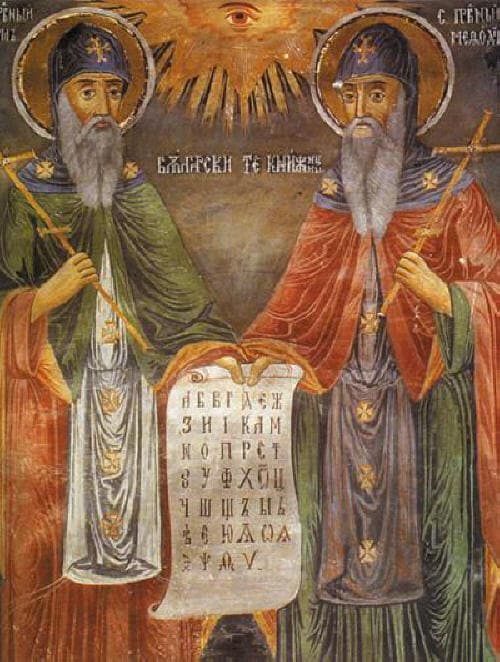
Saints Cyril and Methodius, fresco by Zahari Zograf, 1848, Troyan Monastery · Public Domain
Why He Matters
Cyril and Methodius show that making the Gospel genuinely understandable to a people — even when that means inventing new tools from scratch — can matter as much as any single sermon, and that a mission worth starting is often worth defending through real institutional opposition.
Virtue for Today
Cultural Bridges
Try Today
Explain something you understand well to someone in the simplest, clearest language you can, adapting it fully to how they think rather than how you naturally would.
Brothers From Thessalonica
Cyril (born Constantine, in 826 or 827) and Methodius (born around 815) were brothers from Thessalonica, then part of the Byzantine Empire, sons of an imperial official. Methodius, the elder, entered imperial administration before becoming a monk; Cyril, recognized early as unusually gifted, was educated at the imperial court in Constantinople alongside the young Emperor Michael III, studying under the future Patriarch Photius before becoming a priest and a noted scholar and teacher, eventually lecturing in philosophy.
The Khazar Mission
The brothers' partnership as missionaries began when the Byzantine court sent them together to the Khazars, a Turkic people north of the Black Sea, in response to a request for a Christian teacher able to debate matters of faith with Jewish and Muslim scholars at the Khazar court. The mission gave the brothers early, formative experience working as a team across languages and cultures, experience that would prove decisive a few years later.
Inventing an Alphabet
In 862, Prince Rastislav of Moravia (a Slavic territory in what is now roughly the Czech Republic and Slovakia) asked Constantinople for missionaries who could teach and worship with his people in their own Slavic language, rather than in Latin or Greek, neither of which the Moravians understood. Cyril's response was extraordinary: since no written form of the Slavic language existed, he designed one — the Glagolitic alphabet — specifically to represent Slavic sounds accurately. With Methodius's help, he then began translating the Gospels, the Psalms, and the texts needed for the liturgy into Old Church Slavonic, the first time the Slavic vernacular had ever been rendered into writing. (The Cyrillic alphabet used across much of the Slavic world today was developed slightly later by their disciples and named in Cyril's honor, building on his original work.)
Summoned to Rome
The brothers' use of a vernacular liturgy provoked strong opposition from German-speaking clergy in the region, who held that only Latin, Greek, or Hebrew were fit liturgical languages and viewed the brothers' Moravian mission as a rival jurisdiction. Summoned to Rome to answer for it around 867, Cyril and Methodius instead won a surprising victory: Pope Adrian II examined their translated texts, approved the Slavonic liturgy, and had it solemnly celebrated in Roman churches, personally ordaining Methodius a bishop. Cyril, however, fell seriously ill in Rome and died there on February 14, 869, having taken monastic vows and the name Cyril shortly before his death, after urging his brother in his final words not to abandon their shared mission for the safety of a quiet monastery: "we have shared the same destiny, ploughing the same furrow."
Methodius Carries On Alone
Methodius returned to Moravia as archbishop, but spent much of the rest of his life defending the Slavonic liturgy against renewed opposition — at one point he was imprisoned for roughly two years by rival Frankish bishops before Pope John VIII intervened to secure his release and reaffirm papal support for his mission. Methodius continued translating Scripture and ecclesiastical texts into Slavonic until his death on April 6, 885. Their disciples, expelled from Moravia after his death, carried the Slavonic liturgical tradition into Bulgaria and beyond, permanently shaping the religious and literary culture of the Slavic world. In 1980, Pope John Paul II declared Cyril and Methodius co-patrons of Europe, alongside St. Benedict.
Helper
Reflection Questions:
- Cyril built an entirely new tool — a written alphabet — simply so people could receive the Gospel in a language they actually understood. What barriers, small or large, keep people around you from understanding something important?
- The brothers faced serious institutional opposition for insisting ordinary people should worship in their own language. Where do you push for accessibility even when tradition or convenience argues against it?
- Cyril's dying words urged Methodius not to retreat into a quiet, safe monastic life but to keep serving the mission they had begun together. What shared work might you be tempted to abandon once it gets difficult?
- Methodius endured roughly two years of imprisonment for continuing a mission he believed was right. What have you kept doing, quietly and without applause, even under real opposition?
- The brothers' work outlasted both of their lifetimes by centuries, carried forward by disciples after they were gone. What are you building today that depends on other people continuing it after you?
Short Prayer
“Sts. Cyril and Methodius, apostles to the Slavs, pray for us — that we may work to make the Gospel understood by all people, in their own language and on their own terms. Amen.”
Prayer to St. s. Cyril and Methodius
Prayer to Sts. Cyril and Methodius Sts. Cyril and Methodius, you gave an entire people a written language so they could pray, read Scripture, and worship God in words that were truly their own, and you defended that gift through exile, imprisonment, and years of institutional opposition. Pray for us when we are tempted to make faith harder to understand than it needs to be, or when defending what is right costs us comfort and standing. Help us labor together, as you did as brothers, ploughing the same furrow toward the same end. Sts. Cyril and Methodius, pray for us. Amen.
Pope John Paul II, Slavorum Apostoli (1985); Catholic Encyclopedia (New Advent) — "Sts. Cyril and Methodius"; Vatican News — "Sts. Cyril and Methodius"
Grow closer to God.
Agnioz is here to walk with you.
Register for FREE and unlock more Catholic content, prayers, and reflections to help you become a more enlightened Catholic — FREE FOREVER.


Let's grow together in faith, hope, and love. 🙏