
St. s. Perpetua and Felicity: The Prison Diary
of Two Mothers
? – 203
“So also I cannot call myself by any other name than what I am — a Christian.”
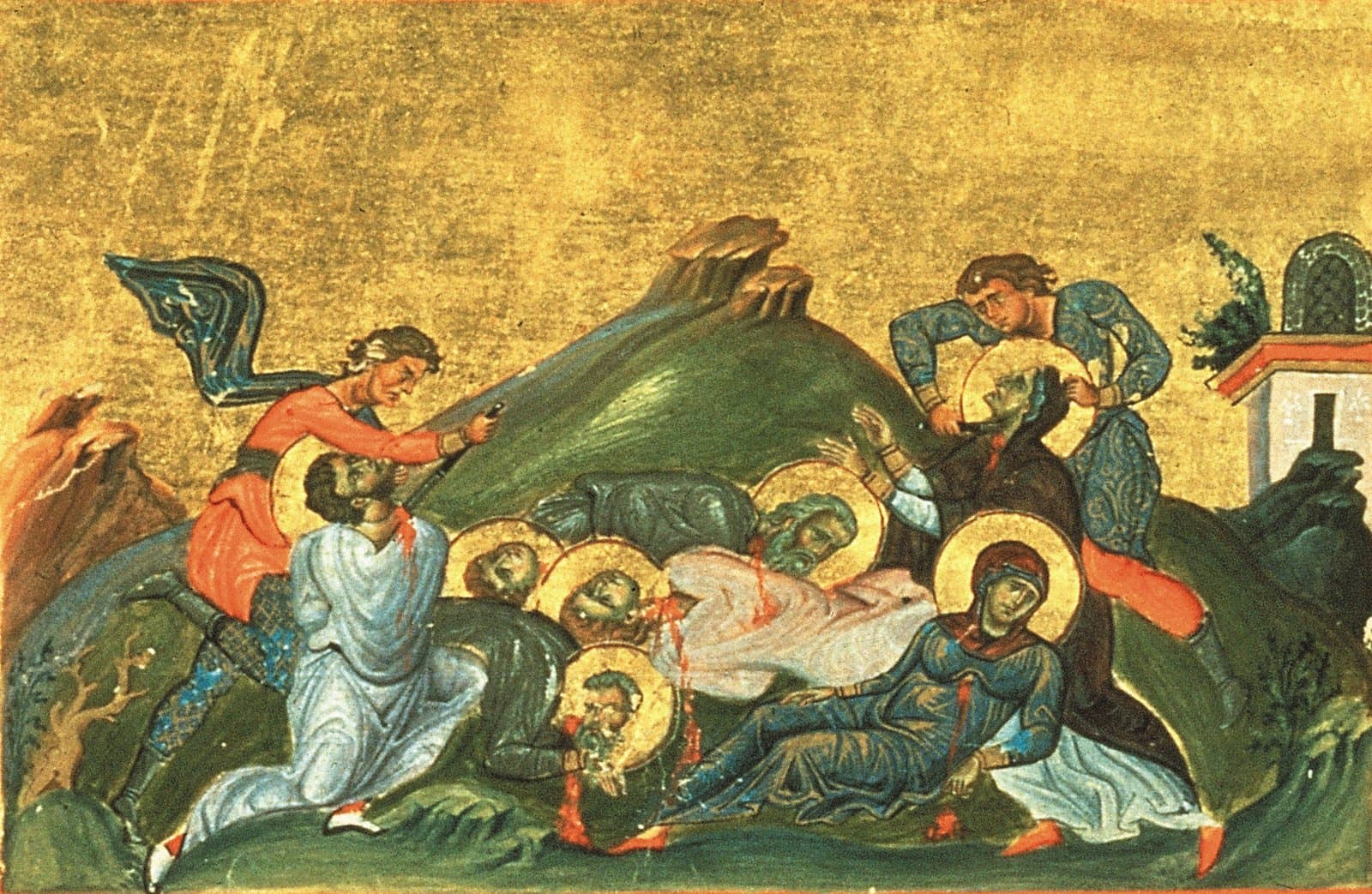
Martyrdom of Perpetua, Felicitas, Revocatus, Saturninus, and Secundulus, illumination from the Menologion of Basil II, c. AD 1000, Vatican Library (Vat. gr. 1613) · Public Domain (PD-old-100-expired)
Why She Matters
Perpetua's prison diary is one of the earliest surviving Christian texts written by a woman, giving a rare direct, first-person account of faith under persecution rather than a later retelling. Together with Felicity, an enslaved woman martyred at her side, their story shows the early Church's witness crossing every line of class and status, and their names are still honored by name at every Mass that prays the Roman Canon.
Virtue for Today
Courage in Suffering
Try Today
Read Perpetua's own words about the vessel and her identity, and ask yourself what you would answer if pressed the same way today.
Two Women, One Cell
In AD 203, in the Roman province of Africa, a group of catechumens — Christians preparing for baptism — were arrested in Carthage under a persecution ordered by the emperor Septimius Severus. Among them were Vibia Perpetua, a twenty-two-year-old married noblewoman still nursing an infant son, and Felicity, a pregnant enslaved woman imprisoned alongside her. They were held together with three companions, Revocatus, Saturninus, and Secundulus, along with their catechist, Saturus, who would later voluntarily join them in prison and in death.
A Diary Written From Inside a Cell
What makes their story historically extraordinary is not only their martyrdom but its documentation. A substantial portion of The Passion of Saints Perpetua and Felicity is presented as Perpetua's own prison diary, written in the first person, recording her visions, her fear, and her repeated confrontations with her father, who visited her again and again begging her to recant for the sake of her family and her infant son. Scholars regard this diary section as one of the earliest surviving Christian texts written by a woman — a rare, direct first-person voice from the very early Church, later completed and circulated by another hand, quite possibly Tertullian, after her death.
"I Cannot Call Myself Anything Other Than What I Am"
In one especially vivid exchange, her father pointed to a household vessel and asked whether it could be called by any name other than what it was. When Perpetua agreed it could not, he pressed his point — surely, then, she likewise could not call herself anything other than his daughter. Perpetua turned his own logic back on him: "So also I cannot call myself by any other name than what I am — a Christian." It was a direct, recorded refusal, in her own words, to trade her identity in Christ for her family's approval or her own safety.
Felicity's Fear and Its Resolution
Felicity faced a separate anguish: Roman law forbade the execution of pregnant women, and she feared she would be separated from her companions and martyred alone, later, among strangers, rather than dying together with the community she had come to love. Two days before the scheduled games, she gave birth to a daughter in prison — the child was taken in and raised by a Christian woman in the community — and Felicity was able to face the arena together with Perpetua and the others, exactly as she had prayed to do.
Martyred Together in the Arena
On March 7, 203, the group was led into the amphitheater at Carthage as part of games celebrating the birthday of the emperor's son. Perpetua and Felicity were attacked by a wild heifer, chosen, according to the account, specifically because they were women. Both survived the initial mauling; witnesses recorded that the two women stood, embraced and kissed each other, before gladiators finished the executions with the sword. The account states that Perpetua, still conscious, guided the trembling hand of the inexperienced young gladiator to her own throat.
Honored at the Heart of the Mass
Their witness was treasured immediately: St. Augustine, more than a century later, preached multiple sermons in their honor, remarking on how remarkable it was that so much of their story survived in a woman's own words. Their names are included together among the small number of early martyrs listed by name in the Roman Canon, the First Eucharistic Prayer still prayed at Mass today — a mark of how central their memory became to the early Church's self-understanding.
Helper
Reflection Questions:
- Perpetua's father tried repeatedly to talk her out of her faith by appealing to family loyalty. Has anyone you love ever asked you to soften or hide your faith for their comfort, and how did you respond?
- Felicity feared being separated from her companions in her final trial and prayed specifically to face it together with them. Who are the people you most want beside you in your hardest moments, and are you investing in those relationships now?
- Perpetua wrote her diary from inside a prison cell, not knowing if anyone would ever read it. Is there a part of your own faith journey worth writing down, even privately, for what it might mean to you or someone else later?
- She refused to be called anything other than what she truly was — a Christian — even at the cost of her family's approval. Is there an area of your life where you soften your identity in Christ to avoid tension?
- Their names are still spoken at every Mass that uses the Roman Canon, twenty centuries later. What does it mean to you that ordinary people''s faithfulness can be remembered for that long?
Short Prayer
“Sts. Perpetua and Felicity, pray for us — that we may hold onto our identity in Christ as firmly as you held onto yours. Amen.”
Prayer to St. s. Perpetua and Felicity
Prayer to Sts. Perpetua and Felicity Sts. Perpetua and Felicity, one of you a young mother of noble birth, the other an enslaved woman about to give birth herself, you faced imprisonment and death together and would not be separated, even by the different laws that governed your different stations in life. Perpetua, you wrote down your fear and your resolve in your own words, refusing every plea to call yourself anything other than what you were. Felicity, you prayed only to face the end alongside the friends you loved, and your prayer was answered. Pray for us in whatever trial tempts us to hide our identity in Christ for safety or approval. Help us hold on to what we are, plainly and without apology, as you both did to the very end. Sts. Perpetua and Felicity, pray for us. Amen.
The Passion of Saints Perpetua and Felicity (Passio Sanctarum Perpetuae et Felicitatis, c. AD 203, incorporating Perpetua's own prison diary); Roman Canon (Eucharistic Prayer I); Catholic Encyclopedia (New Advent), "Sts. Perpetua and Felicitas"

Grow closer to God.
Agnioz is here to walk with you.
Register for FREE and unlock more Catholic content, prayers, and reflections to help you become a more enlightened Catholic — FREE FOREVER.


Let's grow together in faith, hope, and love. 🙏