The Mass and the Eucharist: The Church's Greatest Act of Spiritual Warfare
Why the Catholic tradition calls the Mass — not a blessed object, not a prayer formula — the Church's supreme weapon against evil: the theology of the one Sacrifice re-presented, the Real Presence as "source and summit," the forgotten history of the Leonine Prayers and the St. Michael prayer, and why exorcists point the faithful first to the altar.
Catholic Editorial Review
Are you Catholic clergy or a formation professional?
Your expertise can help keep this article faithful, precise, and well-sourced.
According to a later Catholic tradition, sometime during the pontificate of Pope Leo XIII — often dated to October 13, 1884 — the pope reportedly experienced something extraordinary after celebrating Mass in his private Vatican chapel. Later accounts describe him as visibly shaken, his face gone the color of ash, and associate the experience with the development of the St. Michael Prayer: some tellings describe him as having overheard a voice boasting that it could destroy the Church, if only it were given more time and greater power over the men of the coming century. No signed account from Leo XIII himself survives, and historians differ over the date, details, and precise connection between the reported experience and the prayer.
What is historically documented is that Leo XIII established post-Mass prayers in the 1880s and that the Prayer to St. Michael became part of the Leonine discipline — recited, on your knees, at the foot of every altar in the Latin Church, immediately after Mass had ended. Whether these developments were directly caused by the extraordinary experience later attributed to him cannot be established with certainty.
That detail is the whole point of this article. The Church's instinctive response to the reality of evil has never been a special ritual bolted onto the side of ordinary Catholic life. It has always been the Mass itself — and what follows from it. Before we return to Leo XIII and his prayer, we need to understand why.
A note on this article's title: the phrase "the Church's greatest act of spiritual warfare" is a pastoral and theological way of describing the Eucharist's place in the Christian struggle against sin and evil. It is not an official liturgical or magisterial title for the Mass. The Church more formally describes the Eucharist as the source and summit of the Christian life, the memorial of Christ's Paschal Mystery, the sacramental sacrifice of Christ and his Body, and the sacred banquet in which Christ himself is truly received (CCC 1324; CCC 1362–1372). Keeping that distinction in mind is what allows this article to say something bold about the Mass without turning it into something it is not — a stronger spell, a religious technology, or a rival to the many good sacramentals Catholics also rightly use.
1. Not a Ritual Competing With Evil — Christ's Own Victory, Made Present
It is tempting to think of the Mass as one spiritual weapon among many: holy water on one shelf, a blessed medal on another, the Mass somewhere in the mix as a particularly strong prayer. That instinct, however pious, misses what the Church actually teaches.
The Catechism is precise on this point. The Mass is not a re-enactment of Calvary, and it is not a new sacrifice added to the first one. It is the very same sacrifice, made present under a different mode:
The sacrifice of Christ and the sacrifice of the Eucharist are one single sacrifice: "The victim is one and the same: the same now offers through the ministry of priests, who then offered himself on the cross; only the manner of offering is different." ... "In this divine sacrifice which is celebrated in the Mass, the same Christ who offered himself once in a bloody manner on the altar of the cross is contained and is offered in an unbloody manner." (CCC 1367) (Vatican)
This is why the Mass is not, theologically speaking, a human ritual that competes with evil "on its own level," the way a spell or a counter-charm might claim to out-power a curse. Scripture describes Calvary itself as the decisive defeat of the powers of darkness — Christ "disarmed the principalities and powers and made a public example of them, triumphing over them" on the cross (Colossians 2:15, RSV). The Mass does not repeat or add to Christ's victory. In the Eucharistic sacrifice, the one sacrifice of Calvary is made sacramentally present, and its saving fruits are communicated to the Church. When a priest stands at the altar, he is not summoning a new power against evil. He is placing the whole assembly, once again, inside Christ's own accomplished triumph.
For this reason, the Mass can rightly be understood, in a pastoral and theological sense, as standing at the very heart of Catholic spiritual warfare — not because it works like a stronger spell, but because it isn't a spell at all. The Eucharist is the source and summit of the Christian life (CCC 1324): in the Mass, Christ's once-for-all Paschal Sacrifice is uniquely made sacramentally present, its saving fruits applied to the Church (CCC 1366), and the faithful united to his Paschal victory. The Eucharistic sacrifice does not repeat Calvary; the sacrifice of Christ and the sacrifice of the Eucharist are one single sacrifice, differing only in the manner of offering (CCC 1367; cf. Council of Trent, Session XXII).
But when Christ had offered for all time a single sacrifice for sins, he sat down at the right hand of God... For by a single offering he has perfected for all time those who are sanctified.
— Hebrews 10:12–14
2. The Real Presence: "The Source and Summit"
Underneath the Mass's power as sacrifice lies something even more basic: what actually happens on the altar. The bread and wine, the Church teaches, truly become the Body and Blood of Christ — not a symbol of him, not a reminder of him, but him.
The mode of Christ's presence under the Eucharistic species is unique. It raises the Eucharist above all the sacraments as "the perfection of the spiritual life and the end to which all the sacraments tend." In the Blessed Sacrament of the Eucharist "the body and blood, together with the soul and divinity, of our Lord Jesus Christ and, therefore, the whole Christ is truly, really, and substantially contained." (CCC 1374) (Vatican)
This is why the Catechism, quoting the Second Vatican Council's Lumen Gentium, gives the Eucharist a title it gives no other sacrament:
The Eucharist is "the source and summit of the Christian life." (CCC 1324, citing Lumen Gentium 11) (Vatican)
The other sacraments, ecclesial ministries and apostolic works are bound up with the Eucharist and ordered toward it, since it is the source and summit of the Christian life (CCC 1324). Sacramentals and authentic devotions prepare the faithful to receive grace and help sanctify the circumstances of everyday Christian life (CCC 1667–1670); none of them replace the Eucharist, and none of them outrank it. That reality fundamentally reorders how a Catholic thinks about spiritual protection: our confidence is not ultimately placed in objects, techniques, or formulas, but in communion with Jesus Christ himself, truly present in the Eucharist.
For my flesh is food indeed, and my blood is drink indeed. He who eats my flesh and drinks my blood abides in me, and I in him.
— John 6:55–56
Did you know? The word "Mass" comes from the Latin dismissal Ite, missa est — roughly, "Go, it is sent" or "Go, you are sent forth." The very name of the liturgy is a commissioning: Catholics don't merely attend Mass and leave unchanged. They are sent out from it, carrying Christ, into a world that needs him.
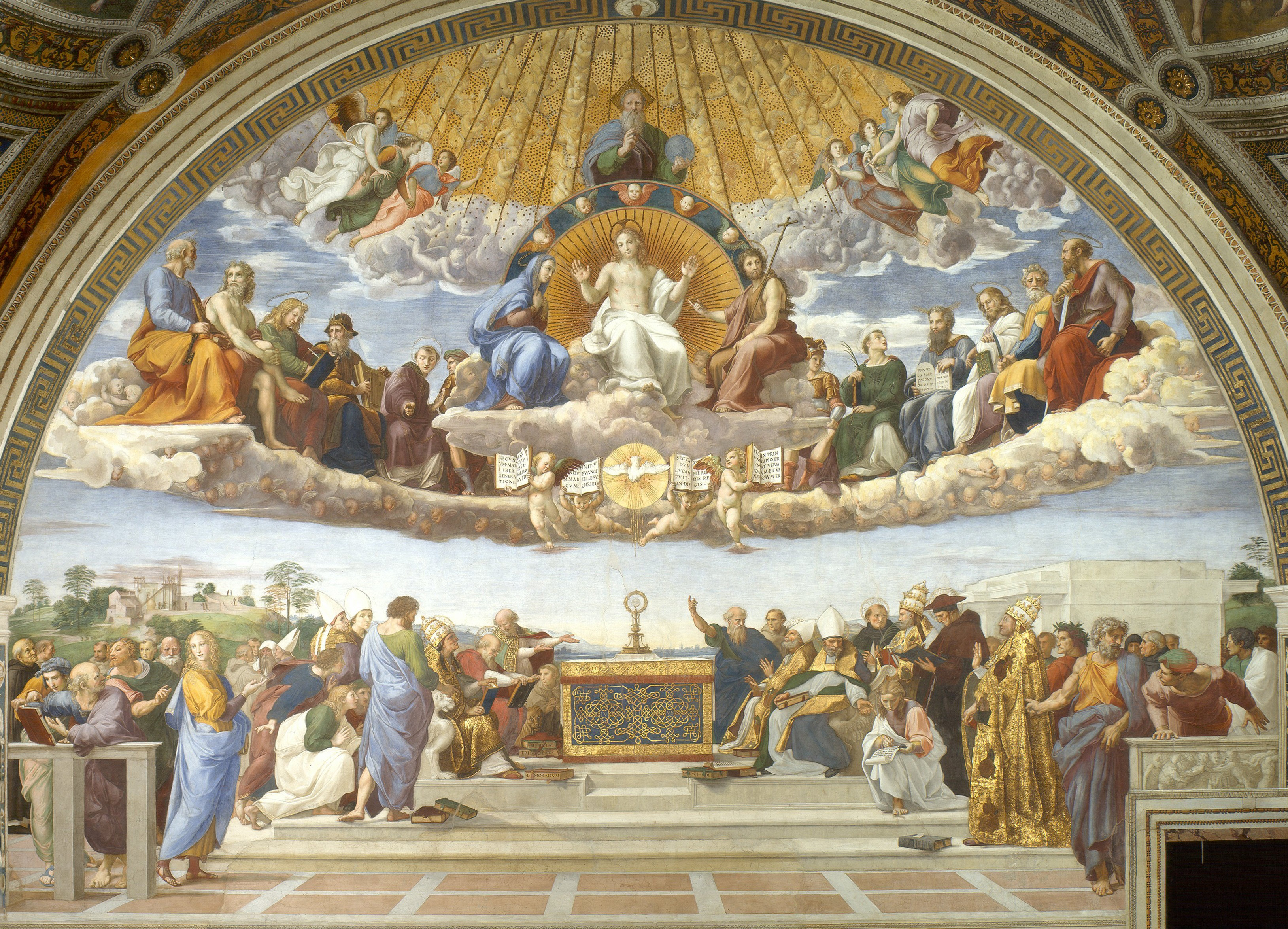 Disputation of the Holy Sacrament, fresco by Raphael, 1509–1510, Apostolic Palace, Vatican (Public Domain, Wikimedia Commons)
3. The Eucharist Is Not a Spiritual Talisman: Worthy Communion Matters
Everything said so far could be badly misunderstood in one direction. If the Eucharist really is Christ himself, truly, really and substantially present (CCC 1374), it can start to sound like a supernatural object a Catholic simply needs to "get access to" — a stronger amulet than a blessed medal, a spiritual technology that works automatically once it is consumed. That is not Catholic teaching, and it deserves to be said plainly: the Eucharist must never be treated as a magical object, a supernatural charm, or a piece of spiritual technology. Christ is not a talisman.
The sacraments truly act through the saving power of Christ himself, not through any power of the minister or the recipient (CCC 1128). But the fruit a sacrament bears in the person who receives it also depends on that person's own disposition. Holy Communion is not simply "getting the Eucharist into oneself." Worthy reception involves faith, reverence, repentance and communion with the Church — receiving Christ as one who belongs to him, not as one collecting a spiritual benefit.
This is also why the Church asks a Catholic who is conscious of having committed mortal sin to seek sacramental absolution before receiving Holy Communion (CCC 1385; Canon 916; cf. 1 Corinthians 11:27–29). Spiritual warfare, understood this way, can never be separated from repentance and conversion. A person cannot fight sin by receiving Communion while refusing to let go of grave sin.
None of this makes the Eucharist smaller. Received worthily, Holy Communion does everything the Church has always said it does: it strengthens our union with Christ, separates us from sin, wipes away venial sins, and helps preserve us from future mortal sin (CCC 1391–1395; CCC 1415–1416). It also builds up the one Body of Christ (CCC 1396). But it does all of this as an encounter with a Person who conforms the one who receives him more deeply to himself — not as an object that changes the world magically around the one who possesses it.
The Eucharist does not function as magic against an external enemy. Rather, Christ conforms the communicant more deeply to himself. The strongest Eucharistic "protection" is therefore not superstition but communion with Christ, conversion of life and growth in charity.
Do Not Turn the Eucharist Into a Deliverance Technique
The Eucharist is not spiritual technology, and Holy Communion should never be received merely to "block a curse," "remove an attachment," or obtain automatic protection, as if grace worked like a charm. A consecrated Host must never be taken from a church for private deliverance rituals, placed around a house, or mixed with sacramentals as though it were itself a protective object — the Eucharist remains under the sacramental and liturgical discipline of the Church at all times (cf. Code of Canon Law, canons on the reservation and worship of the Most Holy Eucharist; Redemptionis Sacramentum). The right response to the Eucharist is faith, adoration, repentance, worthy Communion, thanksgiving and charity — not superstition.
4. The Mass Already Contains a Prayer of Deliverance
It can be tempting, once a Catholic starts thinking seriously about spiritual warfare, to want to add something extra to the Mass — an improvised prayer of deliverance, a private exorcism formula recited under one's breath, an extra ritual bolted onto the liturgy to make it feel more combative. None of that is necessary, because the Roman liturgy already contains exactly this prayer, prayed by the whole Church, every single time Mass is offered.
Immediately after the Lord's Prayer, the priest prays what liturgists call the embolism — an expansion of the Our Father's final petition, "deliver us from evil" (Matthew 6:13):
Deliver us, Lord, we pray, from every evil, graciously grant peace in our days, that, by the help of your mercy, we may be always free from sin and safe from all distress, as we await the blessed hope and the coming of our Savior, Jesus Christ.
The General Instruction of the Roman Missal explains that in this prayer, the priest asks "deliverance from the power of evil for the whole community of the faithful" (GIRM, no. 81). This is not a minor rubric. In the ordinary Christian sense of the word "deliverance," the embolism is one of the Church's universal liturgical prayers for freedom from evil. It is not an exorcism rite: a solemn or major exorcism is a distinct, canonically regulated rite directed to cases of alleged demonic possession and may be performed only by a priest who has received the local ordinary's special and express permission (Canon 1172; CCC 1673). Other prayers for liberation or deliverance must likewise remain within the Church's pastoral and liturgical discipline. The embolism, prayed by every priest at every Mass, asks to be freed from evil, from sin, from distress, and given peace, while the Church waits in hope for Christ's return.
Catholics do not need to transform the Mass into an improvised deliverance service. The Roman liturgy already prays, on behalf of every person present, for deliverance from evil, freedom from sin, peace, protection from distress, and hope in Christ's return. This is authentic Catholic spiritual warfare: the Church does not obsess over demons; she turns toward God and asks to be freed from evil so that she may live in holiness, peace and hope.
5. The First Battlefield Is the Human Heart
It would be easy, after several sections about the Eucharist, demons and dramatic historical episodes, to conclude that Catholic spiritual warfare is mainly about extraordinary demonic activity — hauntings, curses, oppression, possession. For the overwhelming majority of Catholics, on the overwhelming majority of days, it is not.
The Catechism describes prayer itself as a battle: "Prayer is both a gift of grace and a determined response on our part. It always presupposes effort... prayer is a battle. Against whom? Against ourselves and against the wiles of the tempter who does all he can to turn man away from prayer" (CCC 2725). The struggles the Catechism goes on to describe are not exorcisms. They are the ordinary difficulties of a life turned toward God: distraction, dryness, discouragement, and the daily temptation simply not to pray at all.
For most Catholics, most of the time, the real battlefield of spiritual warfare is not a haunted room. It is pride, resentment, lust, greed, envy, habitual sin, unforgiveness, discouragement, distraction in prayer, spiritual laziness, indifference toward God, and resistance to grace. St. Paul's language about "the whole armor of God" and struggling "against the spiritual forces of evil" (Ephesians 6:10–18) is not primarily a summons to hunt for demons. It is a summons to a lifetime of ordinary, unglamorous fidelity.
The primary question of Catholic spiritual warfare is not, "How do I attack the devil?" but, "How deeply will I allow Christ to transform me?"
Not every frightening experience, intrusive thought, nightmare, illness, emotional crisis, addiction, family conflict or unusual experience should be interpreted as demonic activity. Ordinary human suffering often has ordinary human causes, and pastoral discernment — including appropriate medical and psychological evaluation — is itself an act of Catholic wisdom, not a lack of faith. A genuinely extraordinary case belongs with legitimate diocesan authority, not with self-diagnosis of possession, oppression, obsession or infestation.
6. When the Whole Church Knelt After Every Mass: The Leonine Prayers
For eighty years, Catholics attending a Low Mass anywhere in the Latin Church experienced something few remember today. After the priest gave the final blessing, he and the congregation knelt back down at the altar rail and prayed together: three Hail Marys, the Hail, Holy Queen, a prayer for the Church's freedom, and — from 1886 onward — the prayer to St. Michael the Archangel. Pope Pius X later added a threefold invocation of the Sacred Heart in 1904.
These became known as the Leonine Prayers, after the pope who instituted them. Leo XIII first ordered a form of them in 1884, asking God's help for the besieged temporal position of the Holy See; in 1886, he added the St. Michael prayer and made the fuller set obligatory throughout the Latin Church. For generations, a Catholic could not attend a said Mass without also praying, on his knees, for protection against "the wickedness and snares of the devil."
The practice ended in the reforms following the Second Vatican Council. Pope Paul VI's 1964 instruction Inter Oecumenici, implementing the Council's liturgical reform, suppressed the obligation to recite the Leonine Prayers, effective in 1965 — not because the Church stopped believing in the reality of spiritual combat, but because the postconciliar reform wanted the Mass's own rites, beginning and ending at the altar, to stand without an appended block of devotional prayers. The St. Michael prayer itself was never suppressed as a prayer; countless parishes today have simply chosen, on their own initiative, to reintroduce it after Mass, and Pope St. John Paul II and later Pope Francis both publicly encouraged Catholics to keep praying it.
Did you know? For eighty years, kneeling to ask St. Michael's protection was not a private devotion for the spiritually anxious — it was simply what happened, by universal law, at the end of every quiet Mass in the Catholic world.
7. The Pope Who Saw Satan's Hour
Return, now, to Leo XIII in his chapel. The story of his vision is one of the most widely repeated in modern Catholic memory, and it deserves to be told carefully rather than dramatically.
It is not a Church dogma, and it appears nowhere in an official Vatican document under the pope's own signature. It comes down through later Catholic testimony associated with members of Leo XIII's household and Curia, but no signed account from the pope himself survives — a tradition the Church has never denied, but also never formally canonized as fact. Accounts differ on small details: whether it happened in 1884 or slightly later, whether Leo described "a conversation" he overheard or simply "a vision" he was given, whether he collapsed or merely went pale.
Put simply: later Catholic tradition associated the development of the St. Michael Prayer with an extraordinary experience attributed to Leo XIII. The historical documentation securely establishes the prayer itself and the Leonine discipline that followed it — both are matters of public, verifiable record. The precise details of what Leo XIII experienced, and the exact causal relationship between that experience and his decision to compose the prayer, remain less certain, resting on testimony rather than on the pope's own signed account. It is worth holding these apart clearly: what is documented history (the prayer, the 1886 decree, the discipline observed for eighty years), what is longstanding Catholic tradition (that some extraordinary experience preceded and prompted it), and what belongs to devotional narrative (the vivid, dramatic retellings, which vary in detail from one telling to the next).
Whatever exactly Leo XIII experienced, the Church's own theology helps explain why later Catholic memory naturally connected this tradition with prayer, the altar, and the intercession of St. Michael. The enduring lesson is not the dramatic details of the story, but the Catholic instinct to respond to evil through deeper fidelity to Christ, prayer, and the sacramental life.
Saint Michael the Archangel, defend us in battle. Be our protection against the wickedness and snares of the devil. May God rebuke him, we humbly pray; and do thou, O Prince of the heavenly host, by the power of God, thrust into hell Satan and all the evil spirits who prowl about the world seeking the ruin of souls. Amen.
 Michael the Archangel Defeats Satan, Guido Reni, 1636, Santa Maria della Concezione, Rome (Public Domain, Wikimedia Commons)
8. A Popular Saying, Not Doctrine: "The Devil Does Not Waste His Time on the Indifferent"
Catholics sometimes summarize all of this with a popular saying: "the devil does not waste his time on the indifferent." It is a memorable pastoral aphorism, not a teaching of the Church, and it is worth reading as such — a rough rule of thumb passed down by spiritual writers, not a law of how grace or temptation actually work in every soul.
St. John Vianney, the Curé of Ars, spent up to sixteen hours a day in the confessional, reconciling sinners to God and, in doing so, feeding souls back toward the altar he had just left. For decades he also reported violent nighttime harassment in his rectory: loud crashes, furniture overturned, his bed dragged across the floor with him still in it. He came to refer to his tormentor, half-wearily, as le Grappin — "the Grappin," an old regional word for a devil armed with a pitchfork. Vianney himself connected the disturbances directly to his ministry: he understood the harassment as a direct response to the souls he was drawing away from sin through Confession and toward the Eucharist. It is a pattern reported again in the following century around St. Padre Pio of Pietrelcina, whose own decades at the confessional and the altar in San Giovanni Rotondo were likewise marked by witnessed physical assaults he attributed to diabolical opposition.
Neither saint treated these attacks as evidence of anything wrong with them. Both interpreted these extraordinary experiences within the context of their priestly ministry and their struggle against sin. Their interpretations belong to their personal spiritual histories and should not be generalized into a rule for Christian discipleship. Neither saint's story, however, should become a measuring stick for anyone else's spiritual life.
Whoever wants to draw near to me should not be surprised at the demon's traps. — Traditional summary of St. John Vianney's own teaching on the cost of fruitful priestly ministry
Christians should not conclude that experiencing more temptation or unusual spiritual disturbances proves greater holiness. Nor does the absence of extraordinary experiences imply spiritual indifference. Extraordinary experiences reported in the lives of saints are not the norm of Christian discipleship, and they should never become a diagnostic framework for interpreting ordinary difficulties.
9. The Mass Joins Earth to the Worship of Heaven
Spiritual warfare should not be imagined as isolated Christians standing alone against darkness. In the Eucharistic celebration, the Church on earth worships in communion with the Church in heaven. The Catechism describes the earthly liturgy as a participation, by way of signs, in the liturgy celebrated in the heavenly Jerusalem, toward which the pilgrim Church journeys (CCC 1090; cf. CCC 1137–1139).
This is why, at the heart of every Eucharistic Prayer, the whole assembly sings or says the Sanctus — words drawn from the prophet Isaiah's vision of heaven and echoed in the Book of Revelation's vision of the angels' unceasing worship:
Holy, Holy, Holy Lord God of hosts. Heaven and earth are full of your glory. Hosanna in the highest.
At Mass, a Catholic is not a solitary soldier improvising a defense. He or she joins the angels, the saints already in glory, and the whole pilgrim Church on earth, gathered around the one altar, anticipating the wedding feast of the Lamb (cf. Revelation 19:6–9; CCC 1326). A Catholic entering spiritual combat does not stand alone but participates in the worship — and the strength — of the whole Body of Christ.
10. Adoration: Sitting With the Victor
If the Mass is Calvary made present, then the tabernacle is not simply a cabinet where bread is stored between Masses. It is where the same Christ who is truly present at Mass remains truly present afterward — which is why the Church has always encouraged the faithful to return to him outside of Mass, in silent Eucharistic adoration.
Many Catholic spiritual directors and exorcists encourage Eucharistic Adoration as a powerful part of ordinary Catholic spiritual life, especially when joined to sacramental Confession, worthy reception of Holy Communion, Scripture, conversion, prayer, forgiveness and perseverance in virtue — not because sitting in a chapel is a technique, but because it places a person, undistracted, before the true, real and substantial presence of Christ under the Eucharistic species (CCC 1374; CCC 1378), the one who has already conquered every evil spirit. Time spent this way is not "extra credit" devotion for the especially pious. It is, in the tradition of the saints who practiced it most, a direct and ordinary way of bringing the fruits of Christ's victory into one's daily struggle.
Did you know? A church or chapel with the Blessed Sacrament reserved in the tabernacle traditionally keeps a small lamp — the sanctuary lamp — burning near it at all times, a visible sign that "Someone" is home, day and night, whether or not anyone else is present.
11. The Enemy Divides; Christ Gathers
Authentic Eucharistic spirituality should be recognizable by its fruit, and that fruit is charity. St. Paul writes: "The bread that we break, is it not a participation in the body of Christ? Because there is one bread, we who are many are one body, for we all partake of the one bread" (1 Corinthians 10:16–17). Receiving the one Bread does not simply feed many individuals; it forms the many into one Body (cf. CCC 1396).
Jesus made the connection between the Eucharist and love of neighbor unmistakable at the Last Supper itself: "A new commandment I give to you, that you love one another: just as I have loved you, you also are to love one another. By this all people will know that you are my disciples, if you have love for one another" (John 13:34–35).
This matters directly for anyone thinking seriously about spiritual warfare. Someone who grows increasingly suspicious, hostile, combative, or fixated on spiritual enemies — even while practicing intense Eucharistic devotion — should pause and honestly examine whether that devotion is actually bearing the fruit the Eucharist is meant to bear. One of the clearest signs that Eucharistic spiritual warfare is bearing fruit is not fascination with demons but growth in charity.
12. The Altar and the Confessional Belong Together
If the Eucharist is not a talisman (Section 3) and the real battlefield is usually the human heart (Section 5), then the ordinary shape of Catholic spiritual warfare becomes clear. Spiritual warfare is not ordinarily won by repeatedly commanding evil to depart. For most Catholics, the more demanding battle is repentance: confessing sin, forgiving others, abandoning grave sin, receiving the sacraments worthily and persevering in charity.
The normal path looks like this: conversion, sacramental Confession when necessary, worthy reception of the Eucharist, growth in charity and virtue, resistance to sin, perseverance in grace, and Christian mission lived out in ordinary life.
The Sacrament of Penance exists precisely to reopen that path whenever mortal sin has closed it. Confession is the sacrament of forgiveness through which the sinner is reconciled with God and with the Church (CCC 1422; CCC 1446). It restores sacramental communion with God after mortal sin, which is why the Church asks anyone conscious of grave sin to be reconciled through Confession before approaching Holy Communion (CCC 1457). Its effects reach further still: reconciliation with God and with the Church, and peace and serenity of conscience together with spiritual consolation (CCC 1468–1470).
The altar and the confessional, in other words, are not two separate remedies competing for a Catholic's attention. They belong together, as one path.
13. What This Means in Practice
None of this theology is meant to leave a Catholic feeling that he has one more obligation to master. It resolves, instead, into a short and very old list of habits — deliberately ordinary, and prioritizing the normal means of grace over any extraordinary remedy:
- Remain in, or return to, a state of grace. This is the foundation everything else builds on.
- Attend Sunday Mass faithfully. Sunday Mass fulfills the Church's precept (CCC 2042; Canon 1247), and nothing prevents — and much recommends — attending Mass on ordinary weekdays too, since each Mass applies the same one Sacrifice.
- Receive Holy Communion worthily, with faith, reverence and an examined conscience (cf. 1 Corinthians 11:27–29).
- Go to sacramental Confession regularly, not only when aware of mortal sin, since it disposes the soul to receive the Eucharist fruitfully rather than merely habitually.
- Pray daily, even when prayer feels like effort rather than consolation (cf. CCC 2725).
- Read and meditate on Scripture, letting God's word form the imagination rather than sensational stories.
- Practice forgiveness and reconciliation with those who have wronged us.
- Reject grave sin and the occasions that lead to it.
- Practice charity and works of mercy — the clearest ordinary evidence that grace is taking root.
- Use approved sacramentals properly. A blessed medal, holy water, or the Rosary are good and legitimate aids to holiness, never magical objects or guarantees of protection in themselves. Sacramentals dispose us to receive grace; in the Eucharist we receive Christ himself, the source of every grace, truly, really and substantially present (CCC 1374; cf. CCC 1996–2001).
- Practice Eucharistic Adoration where possible, simply and without any particular technique.
- Seek guidance from a priest when needed, especially in times of significant spiritual struggle.
- Seek appropriate medical or psychological care when symptoms may have natural causes — this is wisdom, not a lack of faith.
- Refer genuinely extraordinary demonic concerns to legitimate diocesan authority, rather than attempting self-diagnosis or private deliverance rituals.
Final Message
Leo XIII's shaken face at the foot of the altar is a striking image, and it is right that it still gets told. But notice, again, what the story is actually about. It is not about a pope discovering a secret weapon the Church had been missing. It is about a pope being reminded, vividly, of the gift the Church had held from the very first Holy Thursday — and responding by asking the faithful to kneel there a little longer.
This brings Catholic spiritual warfare back to its true center: not fascination with the powers of darkness, but communion with Jesus Christ, whose Paschal victory is sacramentally made present in the Eucharist and lived out through repentance, prayer, charity, holiness and faithful participation in the life of the Church.
The Eucharist does not merely defend Christians from evil; it sends them into the world. The goal of spiritual warfare is not simply to remain untouched by darkness, but to become holy enough to love, evangelize, forgive, serve the poor, defend truth and bear witness to Christ (cf. CCC 1324–1327). The dismissal of the Mass matters: Ite, missa est — the Christian who has received Christ is sent forth to live what has been celebrated.
The Christian does not overcome darkness by becoming an expert in darkness. He overcomes by belonging more completely to Christ.
We do not need to search for a "stronger" spiritual technique than the ordinary sacramental life Christ has entrusted to his Church. At its source and summit stands the Holy Eucharist.
Key Catholic References
| Source | What It Covers |
|---|---|
| CCC 1322–1419 | Full teaching on the Eucharist: institution, the Mass as sacrifice, the Real Presence, and Eucharistic worship. |
| CCC 1367, 1374, 1324 | The Mass as the one Sacrifice of Calvary re-presented; the unique Real Presence; the Eucharist as "source and summit" of Christian life. |
| CCC 1385, 1391–1396, 1415–1416 | The disposition needed for worthy Communion, and the fruits of Holy Communion: union with Christ, forgiveness of venial sin, preservation from mortal sin, and the unity of the Church. |
| CCC 1090; 1128; 1137–1139; 1326 | How the sacraments act through Christ's saving power; the pilgrim Church's worship joined to the heavenly liturgy. |
| CCC 1422; 1446; 1457; 1468–1470 | The Sacrament of Penance: its nature, its necessity before Communion after mortal sin, and its effects. |
| CCC 1667–1670 | Sacramentals: what they are, and how they dispose the faithful to receive grace, without ever replacing the sacraments. |
| CCC 2725–2745 | Prayer as a battle — against ourselves and against the tempter — and the ordinary difficulties of a life of prayer. |
| Code of Canon Law, Canon 916 | The norm that a Catholic conscious of grave sin is not to receive Holy Communion without prior sacramental confession, absent grave necessity. |
| Code of Canon Law, Canon 1247 | The Sunday and holy day obligation to participate in Mass. |
| Lumen Gentium 11 | Second Vatican Council's teaching naming the Eucharist the source and summit of the Christian life. |
| General Instruction of the Roman Missal, on the Lord's Prayer and embolism | The Church's own liturgical prayer for deliverance from evil, prayed at every Mass. |
| USCCB — The Real Presence | Overview of the Liturgy of the Eucharist and the Church's teaching on the Real Presence. |
Salamat sa Diyos — thanks be to God — na hindi tayo umaasa sa isang mahiwagang ritwal, kundi sa Kanyang sarili, tunay na naririto sa Banal na Eukaristiya.
Was this article helpful?
Help Us Keep Catholic Formation Faithful
Catholic clergy and qualified formation professionals are invited to review this article or recommend an authoritative source.
Grow closer to God.
Agnioz is here to walk with you.
Register for FREE and unlock more Catholic content, prayers, and reflections to help you become a more enlightened Catholic — FREE FOREVER.


Let's grow together in faith, hope, and love. 🙏