
The World, the Flesh, and the Devil: Naming All Three Enemies of the Soul
The Church's ancient threefold doctrine of temptation -- traceable through the Baptismal Rite's renunciations and classical moral theology -- distinguishing the world (disordered attachment to wealth, status, and approval), the flesh (concupiscence, not the body itself), and the devil (the only one of the three that is a personal, malicious agent), and why correctly naming the source of a temptation matters pastorally.
Catholic Editorial Review
Are you Catholic clergy or a formation professional?
Your expertise can help keep this article faithful, precise, and well-sourced.
On the night before Easter, in a church lit only by candles, a grown man stands at the edge of a pool of water and answers three questions he has rehearsed for months. A priest or deacon asks him, by name: "Do you renounce Satan?" "I do." "And all his works?" "I do." "And all his empty promises?" "I do." Only after the third answer does the priest move on to ask what he believes.
Three separate renunciations, asked one at a time rather than folded into a single question, are the Church's ancient way of insisting that turning to Christ requires a real and specific break with sin and with Satan's dominion — this is not liturgical repetition for its own sake. It would be a mistake, though, to read the three baptismal questions as a coded reference to a different, and more famous, Catholic threefold framework: the world, the flesh, and the devil. The Church has never taught that "Satan," "his works," and "his empty promises" formally correspond, one for one, to those three classical enemies. What the baptismal rite plainly teaches, without needing any hidden code, is that Christian conversion is a real combat against real evil. Naming the shape of that combat more precisely is the work of a separate, equally ancient strand of Catholic spiritual theology — and it is worth learning well, because temptation does not have one address. It has, classically, three — the world, the flesh, and the devil — and getting the source wrong is not a small mistake. It is the difference between fighting the battle a person is actually in and fighting an imaginary one.
1. Three Questions, and a Different Threefold Teaching
The renunciation at the font is ancient. In the Apostolic Tradition, a Church order compiled around the year 215 and long attributed to St. Hippolytus of Rome, the candidate for baptism already answers a threefold form: "I renounce thee, Satan, and all thy service and all thy works." By the time the Roman Ritual reached its classical form, the three questions had crystallized into the version still recognizable today: Dost thou renounce Satan? And all his works? And all his pomps? At the Easter Vigil, the unbaptized elect answer this same threefold renunciation immediately before the water of Baptism is poured; already-baptized candidates completing their initiation into full communion — since they were validly baptized elsewhere and are not baptized again — answer an equivalent threefold renunciation as part of the Church's Renewal of Baptismal Promises. Both groups hear some version of this same threefold form, even though only the elect receive the sacrament of Baptism itself in that moment. The renunciation of sin and Satan remains closely associated with Baptism and is renewed liturgically in the Church, especially in the Easter celebration of baptismal promises, in the familiar "I do" form. (Exact wording varies slightly between liturgical books — the Rite of Baptism for Children has long used "all his empty promises," while some Missal translations render the line "all his empty show" — but the three-part structure has never changed.)
That structure is not incidental. The Church could have written a single, sweeping renunciation — "Do you reject all evil?" — and moved on. Instead, for eighteen centuries, she has asked the question three times rather than once. That liturgical pattern has developed according to its own history and pastoral logic; this article does not claim it was designed to teach, or that it formally encodes, the separate classical framework addressed below. What follows in this article is a different, complementary teaching: not the baptismal rite itself, but the classical Catholic vocabulary — the world, the flesh, and the devil — that spiritual theology has long used to describe where that pressure actually comes from.
2. The Ancient Diagnosis: Naming All Three
St. Paul gives the whole doctrine in two verses, almost in passing, while describing what conversion rescued the Ephesians from:
And you he made alive, when you were dead through the trespasses and sins in which you once walked, following the course of this world, following the prince of the power of the air, the spirit that is now at work in the sons of disobedience. Among these we all once lived in the passions of our flesh, following the desires of body and mind, and so we were by nature children of wrath, like the rest of mankind.
— Ephesians 2:1–3
Read it slowly and the three enemies are already there, named in order: "the course of this world," "the prince of the power of the air" (the devil), and "the passions of our flesh." Paul is not being poetic. He is doing what a good confessor still does today — sorting a single mess of sin back into its three possible sources.
Later theology simply made explicit what Paul had already implied. The twelfth-century philosopher-theologian Peter Abelard named the same three sources of temptation in his scriptural commentaries, fixing them as standard vocabulary for the Scholastic schools that followed. St. Thomas Aquinas later built an entire catechetical instruction on the Lord's Prayer's sixth petition — "lead us not into temptation" — around this same threefold distinction. By the sixteenth century the framework was so settled in Catholic teaching that the Council of Trent could invoke it without explanation, warning the justified not to grow complacent, since:
"They ought to fear for the combat which yet remains with the flesh, with the world, with the devil, wherein they cannot be victorious, unless they be with the grace of God obedient to the Apostle." (Council of Trent, Session VI, Decree on Justification, ch. 13, 1547)
Did you know? The English phrase "the world, the flesh, and the devil" likely entered everyday English not through a theology textbook but a prayer. The 1549 Book of Common Prayer's Litany begged: "From all the deceits of the world, the flesh, and the devil, Good Lord, deliver us" — a triad Catholic ascetical writers had already been using for centuries.
3. The World: When Created Goods Become Rival Gods
Catholic theology distinguishes carefully between two very different things that both get called "the world." The first is God's created world itself — the earth, matter, human society, culture, and work — which Genesis calls good and which Christ came to save, not to abandon. Jesus prayed for his disciples precisely to remain sent into this world, not removed from it:
I have given them thy word; and the world has hated them because they are not of the world, even as I am not of the world. I do not pray that thou shouldst take them out of the world, but that thou shouldst keep them from the evil one. They are not of the world, even as I am not of the world. Sanctify them in the truth; thy word is truth. As thou didst send me into the world, so I have sent them into the world.
— John 17:14–18
"The world" as a classical enemy of the soul means something else: not creation, but a value system opposed to the Gospel — patterns of thought, priorities, and social pressures organized around something other than God. St. John names it directly:
Do not love the world or the things in the world. If any one loves the world, love for the Father is not in him. For all that is in the world, the lust of the flesh and the lust of the eyes and the pride of life, is not of the Father but is of the world. And the world passes away, and the lust of it; but he who does the will of God abides for ever.
— 1 John 2:15–17
St. Paul gives the positive counterpart — not simply avoiding the world's pattern, but actively being transformed out of it:
Do not be conformed to this world but be transformed by the renewal of your mind, that you may prove what is the will of God, what is good and acceptable and perfect.
— Romans 12:2
The Catechism describes how this happens on a scale larger than any one person's private choices. Sin is never merely private; personal sins accumulate into what Scripture calls "the sin of the world," a phrase the Catechism explains this way:
The consequences of original sin and of all men's personal sins put the world as a whole in the sinful condition aptly described in St. John's expression, "the sin of the world." This expression can also refer to the negative influence exerted on people by communal situations and social structures that are the fruit of men's sins. (CCC 408)
This is why "the world" is dangerous in a way the devil, oddly, is not: it requires no active agent at all. It only has to be left unresisted. Its modern faces are ordinary rather than exotic — consumerism that measures a life by what it owns; materialism and a relativism that treats truth itself as negotiable; the corrosive pull of prestige-seeking, corruption, and the pursuit of power for its own sake; a culture that normalizes sexual immorality and dehumanizes the vulnerable; the quiet erosion of conscience produced by greed, revenge culture, and an obsession with image and status; and, for many believing Catholics, a steady social pressure to hide or soften their faith rather than let it be visibly inconvenient. None of this requires a demon whispering in the dark. It requires only an unformed conscience and an unexamined life, absorbing a culture's assumptions the way a person absorbs a native language — without ever consciously choosing to.
None of this means society, culture, or ordinary work is evil, or that matter itself is somehow opposed to spirit. Catholic teaching has always firmly rejected any quasi-Manichaean reading in which the material world, the body, or human institutions are inherently corrupt — that error was condemned centuries ago and has no place in authentic Catholic spirituality. "The world" in this negative, spiritual sense names a disorder within a good creation, not the creation itself.
4. The Flesh: Wounded Desire, Not an Evil Body
Here the classical vocabulary is most easily misheard. "The flesh" does not mean the human body. Catholic anthropology could not be clearer on this point: the body is created by God and is good; the Word himself became flesh (John 1:14); the body is the very instrument through which grace reaches a person in the sacraments; St. Paul calls the Christian's body "a temple of the Holy Spirit" (1 Corinthians 6:19); and every Catholic professes, every time the Creed is recited, belief in the resurrection of the body, not escape from it. Any spirituality that treats the body itself as an obstacle to holiness has already left Catholic teaching behind.
"The flesh," in this traditional spiritual sense, names something more precise: fallen human tendencies insofar as they resist the proper ordering of reason and grace — what Catholic theology calls concupiscence. The Catechism states this precisely:
Although it is proper to each individual, original sin does not have the character of a personal fault in any of Adam's descendants. It is a deprivation of original holiness and justice, but human nature has not been totally corrupted: it is wounded in the natural powers proper to it, subject to ignorance, suffering and the dominion of death, and inclined to sin — an inclination to evil that is called concupiscence. Baptism, by imparting the life of Christ's grace, erases original sin and turns a man back towards God, but the consequences for nature, weakened and inclined to evil, persist in man and summon him to spiritual battle. (CCC 405)
The Catechism returns to this same point when discussing the sacrament of Baptism directly: concupiscence remains in the baptized, not as sin in the proper sense, but as an inclination to sin that must be constantly resisted with the help of God's grace (cf. CCC 1264). It is important to be precise here, because it is easy to overstate the promise: grace does not ordinarily remove every experience of concupiscence during earthly life. Rather, Christ's grace strengthens the baptized to resist disordered desires, grow in virtue, and increasingly order the heart toward God — a lifelong work of cooperation with grace, not a single cure that ends the struggle.
St. Paul lived that battle from the inside and wrote about it more honestly than almost anyone in Scripture:
For I do not do the good I want, but the evil I do not want is what I do... Wretched man that I am! Who will deliver me from this body of death? Thanks be to God through Jesus Christ our Lord!
— Romans 7:19, 24–25
Scholars and spiritual writers have long debated exactly whose experience Paul is describing in this chapter — himself before his conversion, himself after it, or the human condition generally, considered apart from grace. This article does not need to settle that exegetical question to draw the pastoral point that matters: Romans 7 vividly presents the conflict experienced by fallen humanity between the recognition or desire of the good and the power of sin. Catholic spiritual tradition has long found in this passage an important illustration of humanity's need for the grace of Jesus Christ, whatever precise moment of Paul's own life it describes.
Galatians catalogs what this conflict looks like when disordered desire wins, and St. Paul frames it as a struggle between two opposed principles within the same person:
But I say, walk by the Spirit, and do not gratify the desires of the flesh. For the desires of the flesh are against the Spirit, and the desires of the Spirit are against the flesh; for these are opposed to each other, to prevent you from doing what you would. But if you are led by the Spirit you are not under the law. Now the works of the flesh are plain: fornication, impurity, licentiousness, idolatry, sorcery, enmity, strife, jealousy, anger, selfishness, dissension, party spirit, envy, drunkenness, carousing, and the like.
— Galatians 5:16–21
Notice that most of that list — enmity, strife, jealousy, anger, selfishness — has nothing to do with bodily appetite narrowly considered. "The flesh," in Paul's sense and the Church's, is broader than lust: it is the whole disordered pull of a wounded human nature toward whatever is easiest, whatever feels good now, whatever avoids the cost of virtue. St. James adds a clarifying word about how this process actually unfolds, step by step, and why God is never its author:
Let no one say when he is tempted, "I am tempted by God"; for God cannot be tempted with evil and he himself tempts no one; but each person is tempted when he is lured and enticed by his own desire. Then desire when it has conceived gives birth to sin; and sin when it is full-grown brings forth death. Do not be deceived, my beloved brethren.
— James 1:13–16
The Catechism uses the closely related language of "the passions" to describe this same territory: the movements of the sensitive appetite that incline a person toward what is imagined as good, or away from what is imagined as evil. In themselves the passions are neither good nor evil — they are morally qualified only insofar as they actually engage reason and will (cf. CCC 1763–1768). Concupiscence is what results when those passions, wounded by original sin, resist being ordered by reason and grace rather than cooperating with them (cf. CCC 2514–2516).
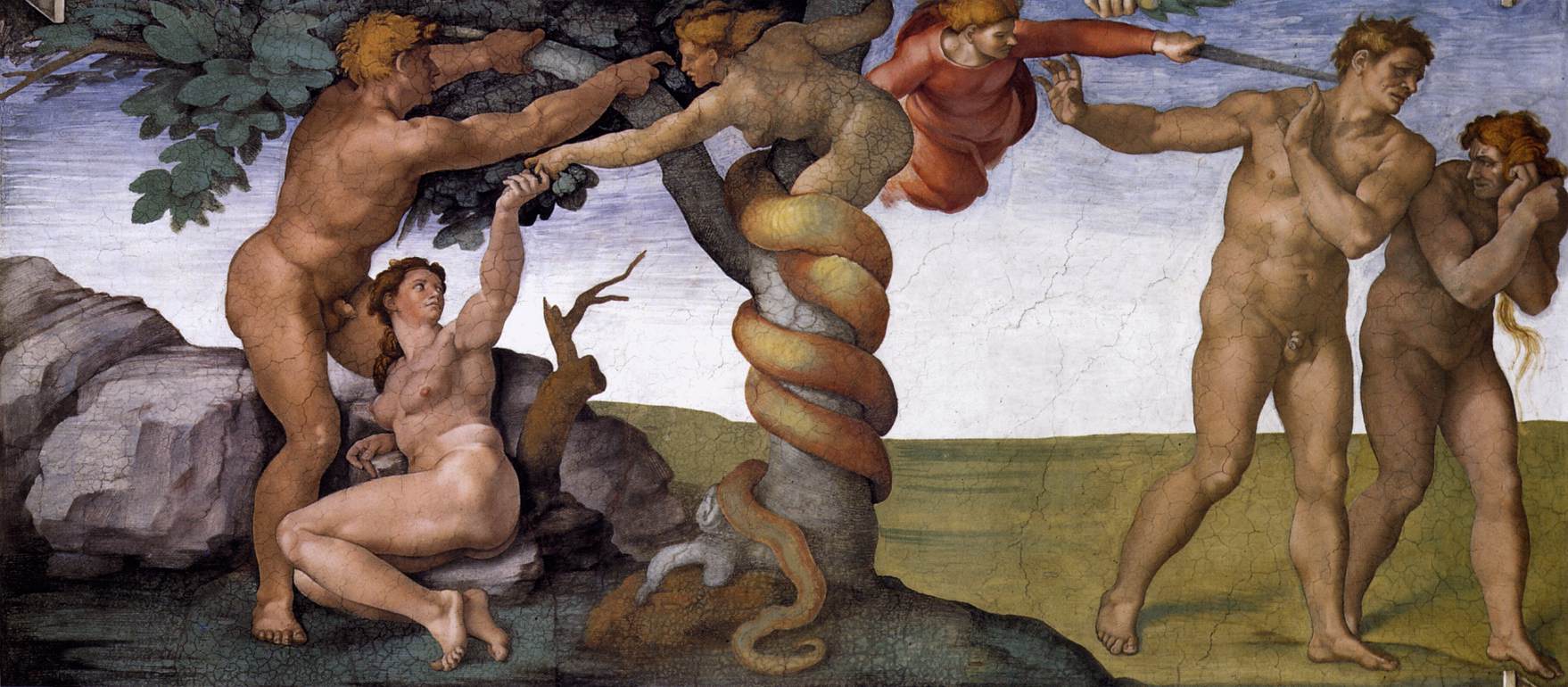 The Fall and Expulsion from the Garden of Eden, Michelangelo, Sistine Chapel ceiling, 1508–1512 (Public Domain, Wikimedia Commons)
5. Temptation Is Not the Same as Sin
This may be the single most pastorally important distinction in the whole subject, and it is worth stating as plainly as possible: a temptation, an unwanted thought, an attraction, a bodily reaction, an intrusive image, an emotion, a memory, a fear, or a sudden impulse is not automatically a personal sin. Feeling a pull toward something disordered is part of living with a wounded human nature in a fallen world. Consenting to it is a different act altogether, and it is consent — not the mere presence of the temptation — that Catholic moral theology has always identified as the place where sin actually begins.
Ordinary Catholic moral reflection has long noticed several distinct moments in this process, without needing a rigid or overly clinical checklist: a temptation presents itself; an attraction or movement of passion may follow, drawing the imagination or the senses toward it; the mind may pause in consideration, weighing the thought rather than dismissing it; and only when the will actually consents — deliberately choosing the disordered object, even briefly — does a chosen action or sin properly occur. Scripture and the Catechism are consistent on this point: sin requires some form of voluntary consent. The Catechism defines sin itself as "an offense against reason, truth, and right conscience," a deliberate thought, word, deed, or omission contrary to the eternal law, and it is precisely the deliberate character of the act — something willed, not merely felt — that makes it sin (cf. CCC 1849–1853).
The most reassuring proof of this distinction is Christ himself. Hebrews states directly that Jesus was tempted in every way that human beings are tempted, and yet remained without sin:
For we have not a high priest who is unable to sympathize with our weaknesses, but one who in every respect has been tempted as we are, yet without sinning.
— Hebrews 4:15
If temptation itself were sin, this verse would be a contradiction rather than a consolation. It is not. Jesus experienced real temptation and never once consented to it — which means that temptation, considered by itself, cannot be what separates a person from God.
This distinction matters enormously for anyone vulnerable to scrupulosity, intrusive thoughts, excessive guilt, sudden anger, unwanted sexual images, or a nagging fear that some passing thought has already condemned them. It has not. A thought that arrives uninvited, is recognized as wrong, and is set aside — even with difficulty, even repeatedly — is not a sin; it is often, in fact, the beginning of virtue, since resisting a real temptation is itself an act of fidelity to Christ. This is a general moral principle, not a diagnosis of anyone's particular psychological condition; a person whose intrusive thoughts are severe, relentless, or connected to genuine anxiety or scrupulosity should be gently encouraged toward both a good confessor or spiritual director and, where appropriate, competent professional care, rather than left to resolve the matter through self-analysis alone.
6. The Devil: Real, Personal — and a Creature
The world is a climate. The flesh is a wound. The devil is neither — he is a someone. Catholic doctrine affirms plainly that Satan and the other demons are real, personal, fallen angels — spiritual creatures who freely and irrevocably rejected God — and not a literary symbol or a poetic name for impersonal evil (cf. CCC 391–395). Scripture describes his malice from its earliest pages, in the serpent's temptation of Eve and Adam:
Now the serpent was more subtle than any other wild creature that the LORD God had made. He said to the woman, "Did God say, 'You shall not eat of any tree of the garden'?" And the woman said to the serpent, "We may eat of the fruit of the trees of the garden; but God said, 'You shall not eat of the fruit of the tree which is in the midst of the garden, neither shall you touch it, lest you die.'" But the serpent said to the woman, "You will not die. For God knows that when you eat of it your eyes will be opened, and you will be like God, knowing good and evil."
— Genesis 3:1–5
That same pattern — deception, half-truth, an appeal to pride dressed as enlightenment — recurs throughout Scripture and Christian experience. St. Peter describes the devil's ongoing hostility in the sharpest possible terms:
Be sober, be watchful. Your adversary the devil prowls around like a roaring lion, seeking some one to devour. Resist him, firm in your faith.
— 1 Peter 5:8–9
And St. James pairs the reality of that adversary with the reader's own responsibility and freedom, in a single verse that anticipates a later section of this article:
Submit yourselves therefore to God. Resist the devil and he will flee from you. Draw near to God and he will draw near to you.
— James 4:7–8
This is the single most important distinction in the entire threefold framework, and the one most often lost. "The world" tempts the way weather erodes stone — impersonally, relentlessly, without malice, simply by being what it is. "The flesh" tempts the way an old injury aches — from inside, without any outside party needed at all. Only "the devil" tempts the way an enemy attacks: with intention and hatred aimed specifically at a soul. St. John, writing to a Church already troubled by false teaching, adds a note of caution that applies just as much to how Christians talk about the devil today as it did to the false prophets of his own time:
Beloved, do not believe every spirit, but test the spirits to see whether they are of God; for many false prophets have gone out into the world... Little children, you are of God, and have overcome them; for he who is in you is greater than he who is in the world.
— 1 John 4:1–4
That last line — "he who is in you is greater than he who is in the world" — is the theological center of gravity for everything that follows in this article. The reality of the devil is never in doubt in Catholic teaching. His ultimate power over a Christian is.
Scripture's very first mention of the devil already points toward his defeat, and toward Mary's place in it. God tells the serpent in the Garden that the woman's offspring "will strike your head, while you strike his heel" (Genesis 3:15). Catholic tradition has long read that verse as pointing, in its fullest sense, to Christ's own definitive victory over Satan — and, inseparably, to Mary, whose "yes" at the Annunciation began to undo what Eve's consent to the serpent had done. A brief prayer asking her intercession in temptation, as the Hail Mary itself does, has long had a place in ordinary Catholic practice — alongside, and never instead of, the direct call on Christ himself.
7. Satan Is a Creature, Not God's Equal
It is possible to affirm the devil's reality so strongly that a subtle distortion creeps in: treating Satan as though he were God's opposite number, locked with him in an uncertain cosmic struggle whose outcome is still genuinely in doubt. That picture, however popular in fiction, has no place in Catholic doctrine. It is a form of practical dualism, and the Church has always rejected it.
Satan is a creature — a fallen angel, not a rival divinity. He was made good by God, like every angel, and became evil by his own free and definitive choice (cf. CCC 391–393). Because he is a creature and not the Creator, his power, however real, is radically limited. He is not omnipotent, not omniscient, and not omnipresent; he cannot act outside the bounds God's providence permits, and he cannot ultimately prevent the coming of God's kingdom. The Catechism states this with striking clarity:
The power of Satan is, nonetheless, not infinite. He is only a creature, powerful from the fact that he is pure spirit, but still a creature. He cannot prevent the building up of God's reign. Although Satan may act in the world out of hatred for God and his kingdom in Jesus Christ, and although his action may cause grave injuries — of a spiritual nature and, indirectly, even of a physical nature — to each man and to society, the action is permitted by divine providence which with strength and gentleness guides human and cosmic history. It is a great mystery that providence should permit diabolical activity, but "we know that in everything God works for good with those who love him." (CCC 395, quoting Romans 8:28)
Christ's Paschal Mystery — his Incarnation, obedience, Passion, Cross, Resurrection, and Ascension, and his gift of the Holy Spirit to the Church — has already, definitively, broken Satan's dominion over those who belong to Christ (cf. CCC 394). This does not mean temptation has ended; it means the outcome of the war is no longer in question, even while individual battles remain to be fought and, sometimes, lost through sin. Catholics do not pray and resist evil in order to help Christ win. They persevere already inside a victory he has won.
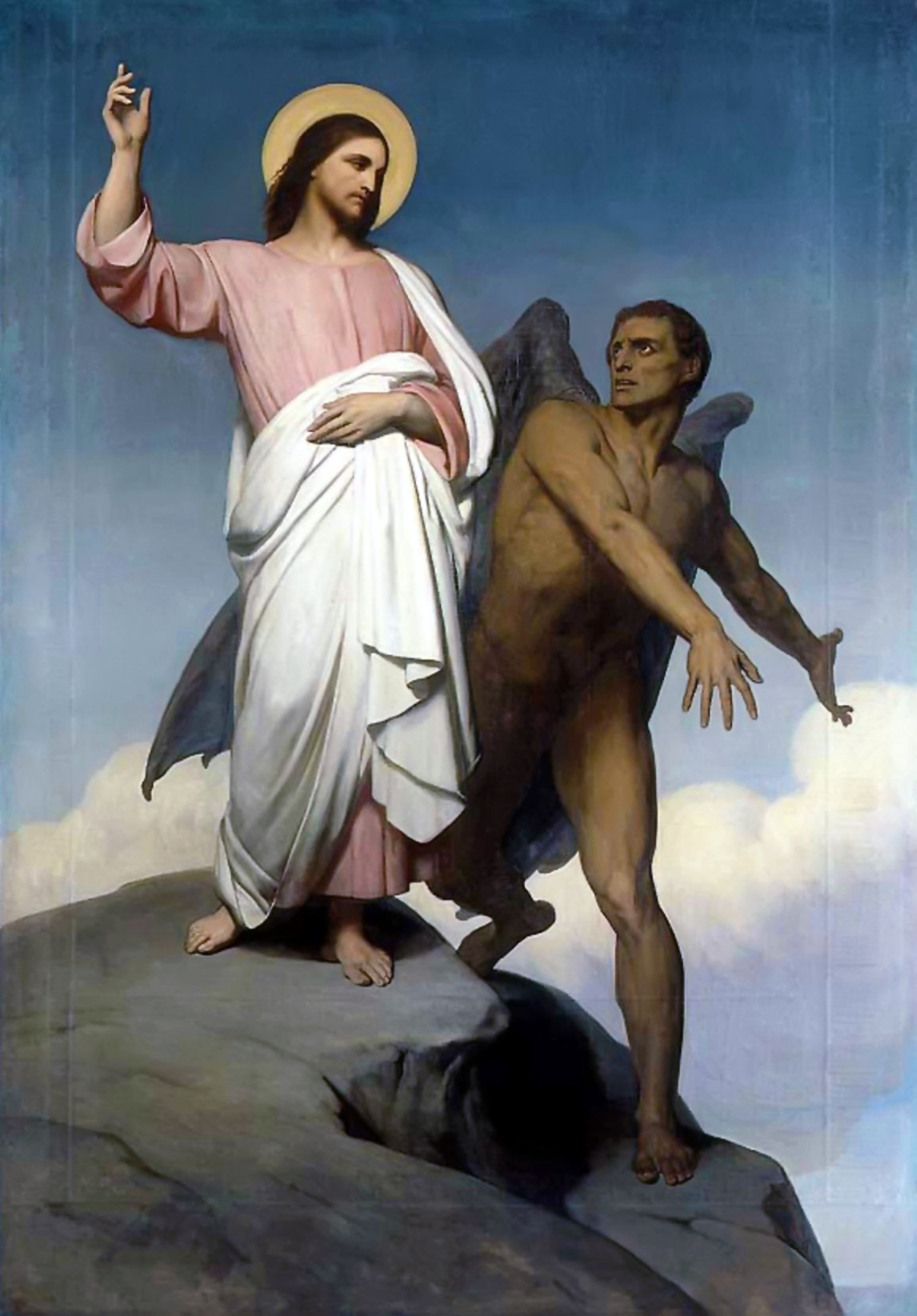 The Temptation of Christ, Ary Scheffer, 1854 (Public Domain, Wikimedia Commons)
8. Christ's Temptation in the Desert
If one scene in Scripture shows all three enemies, and Christ's total mastery over them, it is his forty days in the wilderness, recorded by both Matthew and Luke immediately after his baptism:
Then Jesus was led up by the Spirit into the wilderness to be tempted by the devil. And he fasted forty days and forty nights, and afterward he was hungry. And the tempter came and said to him, "If you are the Son of God, command these stones to become loaves of bread." But he answered, "It is written, 'Man shall not live by bread alone, but by every word that proceeds from the mouth of God.'"... Again, the devil took him to a very high mountain, and showed him all the kingdoms of the world and the glory of them; and he said to him, "All these I will give you, if you will fall down and worship me." Then Jesus said to him, "Begone, Satan! for it is written, 'You shall worship the Lord your God and him only shall you serve.'"
— Matthew 4:1–4, 8–10
(Luke's Gospel records the same three temptations in a different order; see Luke 4:1–13.)
Each temptation targets a different disorder. The offer of bread appeals to immediate gratification — the temptation to reduce a hungry, embodied life to material satisfaction alone, as though the deepest human hunger could be answered by food. The temptation on the parapet of the Temple, in which the devil dares Jesus to throw himself down and be miraculously rescued, is presumption dressed as piety — testing God rather than trusting him, seeking a spectacular sign rather than quiet obedience. And the offer of "all the kingdoms of the world," in exchange for a single act of worship, exposes the deepest of the three: the temptation to seize power, glory, and domination by worshiping something other than God — bowing down, in effect, to a created good in place of the Creator.
It is worth being precise about what this scene does not show. Christ's hunger after forty days of fasting was a real and legitimate bodily need — evidence of his true humanity, not a defect in it — and it is not an instance of "the flesh" in the theological sense used elsewhere in this article. Concupiscence is a disordered inclination rooted in original sin; Christ, conceived without sin, had none to resist. What the desert shows, then, is not the Son of God struggling against an inner disorder he did not have, but the Son of God freely refusing to let a legitimate need, a religious presumption, or an offer of power take the place of trust in the Father — each temptation coming to him from outside, by the devil's suggestion, and answered by a will that never wavered.
Christ's answer to each is the same in kind, even though the words differ: Scripture, obedience, and trust. He does not argue philosophy with the devil or attempt to out-maneuver him rhetorically; he simply holds fast to the Word of God and refuses to worship anything but the Father. The scene is not really about how clever or powerful the devil is. It is about the Son's total fidelity — which is exactly why this article treats it as its central case study. Jesus Christ, not Satan, is the one the reader should finish this passage thinking about.
9. How the Three Enemies Can Work Together
In real life, the world, the flesh, and the devil rarely present themselves with the neat separation this article's three sections might suggest. More often they cooperate, each one preparing the ground for the next. A simple, composite scenario illustrates how:
A surrounding culture quietly equates a person's worth with wealth, status, or success (the world). Over years of unexamined absorption of that message, a wounded, disproportionate desire for recognition and approval takes root inside the person (the flesh). Into that already-vulnerable moment, a subtly deceptive thought arrives, minimizing the cost of a compromise already half-decided: "Everyone does this. Just this once." Whether that final nudge is best described as an ordinary temptation of the flesh reaching its natural conclusion, or as the devil quietly leaning on a door someone else had already left ajar, the person still retains, at every step, the freedom to say no.
These three categories are genuinely useful for spiritual discernment — they help a person locate where resistance is actually needed — but they were never meant to function as a precise supernatural diagnostic system that can sort every temptation into exactly one box with certainty. They overlap constantly. What matters more than assigning the correct label is the last line of the scenario above: the person still has to choose.
10. Human Freedom: The Devil Cannot Force You to Sin
Satan may tempt, suggest, deceive, intimidate, exploit a person's real vulnerabilities, and present evil under the appearance of good. What he cannot do is simply override a human being's free will and compel a sinful choice. "The devil made me do it" is a familiar excuse, but it is not Catholic moral theology. Sin requires the deliberate consent of the will (cf. CCC 1849–1853), and that consent is something only the person himself can give.
St. Thomas Aquinas addresses this directly in the Summa Theologiae (Prima Pars, Question 111, Article 2), teaching that to change the will from within belongs to God alone, and that while an angel or devil can move a person's imagination and sensitive appetite — by suggestion, by persuasion, or by rousing the passions — and thereby incline a person indirectly toward evil, the will itself always remains free to consent to, or resist, that pressure. This is precisely why moral responsibility remains fully in place even when a temptation's ultimate origin is diabolical: influence and suggestion are not the same thing as compulsion.
Catholic moral theology also recognizes, separately from any question of diabolical involvement, that a person's responsibility for a given act can be diminished — though not simply erased — by ignorance, fear, habit, or other psychological and social pressures (cf. CCC 1735). This is one more reason why a genuine, difficult struggle is usually better brought to a confessor or spiritual director than resolved through self-diagnosis alone.
There is a related, more practical point worth adding here. In everyday Christian life, the precise source of a given temptation — worldly, fleshly, or diabolical — can be genuinely difficult, and is sometimes simply impossible, for an ordinary person to identify with certainty, and Catholic spirituality has never made that identification a requirement for holiness. The proper question, most of the time, is not "Was this the devil?" It is a better and more useful question: Is this movement leading me toward or away from truth, charity, virtue, obedience, and Jesus Christ? That question can be answered without solving a mystery that even experienced spiritual directors often cannot solve, and it points straight at what actually needs to happen next — regardless of where the pressure originated.
11. Why the Distinction Matters Pastorally
This is where the doctrine stops being a historical footnote and becomes useful for ordinary Catholic life. Ordinary daily temptation is not usually best explained as direct demonic activity; more often it is the world's pressure to conform, or the flesh's pull toward the easier, more selfish choice. Catholic teaching offers no precise ratio between the three, and the ultimate source of a particular temptation is not always possible to know with certainty — but habitually getting that ordering wrong causes two pastoral problems the Church has had to correct.
The first error is treating every struggle as the devil's direct work — a spiritual cop-out that quietly excuses the person from responsibility. "The devil made me lose my temper" is always more comfortable than "I lost my temper because I am proud, tired, and unwilling to forgive." St. John Chrysostom preached against exactly this instinct in the second of his Three Homilies on the Devil ("On the Power of Man to Resist the Devil"), telling his congregation plainly: "not... that I may discharge the Devil from blame, but that I may free you from slothfulness." His point was not to minimize the devil's malice but to name a real pastoral danger: a person who shifts the blame for ordinary carelessness onto Satan has also excused himself from the work of repentance.
The second error runs the opposite direction: assuming that because most temptation is worldly or fleshly, the devil is never really involved. The Church does not teach that every temptation is the result of direct demonic intervention; many temptations arise through wounded human desires, habits, circumstances, and sinful influences already present in the world. At the same time, Scripture and Tradition affirm that personal demonic temptation is real, and naming a temptation as "worldly" or "fleshly" does not mean the devil has no interest in it at all — he can amplify an already-existing weakness without originating it.
Pastoral Perspectives From Experienced Exorcists
Fr. Gabriele Amorth, who served for decades as an exorcist for the Diocese of Rome, wrote and taught throughout his ministry that the devil's ordinary activity — quietly amplifying the world's and the flesh's existing temptations, discouraging a soul at its weakest moment, nudging an already-selfish impulse a little further than it would have gone alone — is, in his pastoral experience, far more common than the extraordinary phenomena that make headlines. This kind of testimony reflects the accumulated pastoral experience of exorcists and is genuinely valuable. It is not, however, on the same level of authority as Scripture, the Catechism, or official Church teaching, and it should be read as one experienced priest's pastoral insight rather than as magisterial doctrine.
The goal of this whole doctrine was never to make Catholics more afraid. It was to make them more honest about which enemy they are actually fighting on any given day — so that grace can be applied to the right wound.
12. The Seven Capital Sins: Where the Battle Often Becomes Concrete
Catholic moral tradition names seven vices as "capital" — not because they are automatically the gravest possible sins in every instance, but because each one is a fertile root from which other sins tend to grow (cf. CCC 1866). They give the abstract categories of world, flesh, and devil a concrete, recognizable shape in everyday life: pride, avarice (greed), envy, wrath, lust, gluttony, and sloth (acedia).
- Pride inflates the self above God and others — the interior voice that says, in effect, "I know better than everyone, including the Church."
- Avarice treats possessions, money, or security as the real foundation of a good life, never satisfied with enough.
- Envy resents another person's good as though it were a personal loss — "Why did God give that person what I deserve?"
- Wrath seeks to make others suffer for a real or perceived wrong — "I have a right to make them pay."
- Lust disorders sexual desire away from its proper meaning and context within marriage.
- Gluttony disorders the desire for food, drink, or comfort into an end in itself.
- Sloth, or spiritual acedia, is not mere laziness but a weariness with the demands of the spiritual life itself — a temptation to defer conversion indefinitely: "I will pray later. Conversion can wait."
Acting on a capital sin is not automatically a mortal sin. Catholic moral theology teaches that mortal sin requires three conditions together: grave matter, full knowledge, and deliberate consent (cf. CCC 1857). A great deal of ordinary struggle with pride, envy, or sloth remains venial — genuinely serious in its direction and worth real effort to overcome, but not, by itself, severing a person's friendship with God.
(These are illustrative paraphrases of the interior logic of each capital sin, not literal quotations attributed to any demon, saint, or historical source.)
13. The Theological and Cardinal Virtues
Christianity does not merely suppress vice by willpower; grace forms an entirely new life in the believer, rooted in virtues that are themselves gifts before they are achievements. The Catechism organizes these under two familiar headings (cf. CCC 1803–1845). The three theological virtues — faith, hope, and charity — have God himself as their direct object and are infused by grace rather than acquired by repetition alone. The four cardinal virtues — prudence, justice, fortitude, and temperance — are the hinge virtues on which the whole of a well-ordered moral life turns, and grace strengthens a person to grow in them through practice.
Virtue is the positive answer to every one of the capital sins named above: pride is met by humility, greed by generosity, lust by chastity, envy by gratitude and charity, wrath by patience and meekness, gluttony by temperance, and acedia by diligence and perseverance in charity. Spiritual warfare, understood this way, is far more about acquiring virtue than about analyzing vice.
St. Paul's own list of "the works of the flesh," quoted earlier in this article, does not end where it was quoted. The same passage immediately turns to what the Holy Spirit produces in a life actually being transformed: "love, joy, peace, patience, kindness, generosity, faithfulness, gentleness, self-control" (Galatians 5:22–23). Virtue, in Catholic teaching, is not simply self-improvement achieved by effort alone; it is the fruit of the Holy Spirit's own life at work in the baptized, grace bearing fruit rather than willpower succeeding on its own.
14. Three Enemies, Three Different Emphases
Because the three enemies are genuinely different in kind, Catholic ascetical tradition has emphasized somewhat different disciplines for each — though the table below should be read as a pedagogical shorthand rather than a mechanical formula, since Catholic spiritual life is not neatly compartmentalized and every one of the Church's ordinary means of grace strengthens the Christian against all three enemies at once.
| Enemy | Particularly Useful Discipline | Foundational Catholic Response |
|---|---|---|
| The World | detachment, simplicity of life, almsgiving | faith, Scripture, prayer, sacraments, virtue |
| The Flesh | temperance, fasting, mortification | grace, Confession, Eucharist, virtue |
| The Devil | vigilance, resistance, discernment | prayer, the Word of God, sacraments, trust in Christ |
Against the world, the classical remedy is detachment: a deliberate refusal to let money, status, or approval govern the soul's decisions, expressed concretely in almsgiving, generosity, responsible stewardship of material goods, and simply asking, before a major decision, "Am I choosing this because it serves God, or because everyone I know would be impressed?" Catholic teaching asks every believer to give generously in proportion to their means and to care for the poor; it does not bind Catholics, as a matter of universal precept, to a fixed ten-percent tithe in the way some other Christian traditions teach.
Against the flesh, the remedy is mortification, ordinary self-mastery, and — crucially — the sacraments. Concupiscence is not defeated by willpower alone; grace strengthens a person to resist it over a lifetime, chiefly through frequent Confession, the Eucharist, fasting, and the patient practice of virtue. This is the ascetical logic behind the ancient Catholic pairing of prayer, fasting, and almsgiving: almsgiving loosens attachment to possessions, fasting subdues the appetites of the body, and prayer humbles the pride that inflates the self.
Against the devil, the remedy is different again: direct resistance, persevering prayer, and confidence in the authority of Christ's name rather than one's own strength — "Submit yourselves therefore to God. Resist the devil and he will flee from you" (James 4:7). St. Ignatius of Loyola's Rules for the Discernment of Spirits, discussed further below, are built on the observation that the enemy behaves like a coward before a soul that stands firm; ordinary resistance, joined to humble prayer, is the Church's normal response to this kind of direct temptation.
15. The Armor of God
St. Paul closes his letter to the Ephesians with the single most famous image of Catholic spiritual combat, drawn from a Roman soldier's equipment:
Finally, be strong in the Lord and in the strength of his might. Put on the whole armor of God, that you may be able to stand against the wiles of the devil. For we are not contending against flesh and blood, but against the principalities, against the powers, against the world rulers of this present darkness, against the spiritual hosts of wickedness in the heavenly places. Therefore take the whole armor of God, that you may be able to withstand in the evil day, and having done all, to stand. Stand therefore, having girded your loins with truth, and having put on the breastplate of righteousness, and having shod your feet with the equipment of the gospel of peace; besides all these, taking the shield of faith, with which you can quench all the flaming darts of the evil one. And take the helmet of salvation, and the sword of the Spirit, which is the word of God. Pray at all times in the Spirit, with all prayer and supplication.
— Ephesians 6:10–18
Each piece names a real, ordinary element of Christian life rather than a magical accessory: the belt of truth is honesty with God and oneself; the breastplate of righteousness is a life actually conformed to right living, not merely professed; the readiness of the Gospel of peace is a settled willingness to bring the good news wherever one goes; the shield of faith is trust in God strong enough to absorb doubt and attack; the helmet of salvation is hope fixed on the reality of what Christ has already accomplished; and the sword of the Spirit is God's own word, held and used rather than merely possessed. Paul closes the whole image not with another piece of armor but with prayer — "persevering prayer" is what holds the entire picture together. None of this is meant as an occult checklist to be recited like an incantation; it is vivid, memorable language for a life conformed to Christ in truth, righteousness, hope, faith, the Gospel, God's word, and prayer.
16. St. Ignatius and the Discernment of Spirits
St. Ignatius of Loyola, in the Rules for the Discernment of Spirits that form part of his Spiritual Exercises, offers some of the most practically useful Catholic wisdom on how temptation actually operates in a soul. Three of his observations are especially worth knowing.
First, Ignatius compares the enemy's strategy to a military commander surveying a fortress before attacking: the enemy of human nature examines a soul's virtues and vices in turn and attacks precisely at its weakest, most vulnerable point (Spiritual Exercises, First Week, Rule 14). The practical lesson is not paranoia but self-knowledge: a Christian who honestly knows his or her own weak points is far less easily ambushed there.
Second, Ignatius observes that the enemy behaves like a "false lover," desperately wanting a temptation kept secret, and deeply displeased whenever it is brought into the light — confessed, named to a spiritual director, or simply spoken aloud to someone trustworthy (Spiritual Exercises, First Week, Rule 13). Temptation characteristically loses much of its power the moment it is honestly disclosed in Confession or to a competent spiritual director; secrecy is where it grows strongest.
Third, in his Rules for the Second Week, Ignatius warns that evil does not always announce itself as evil. It can initially appear as good — even as something holy, zealous, or righteous — only to lead a soul, step by step, toward pride, contempt for others, disobedience, anxiety, isolation, or a loss of charity (Spiritual Exercises, Second Week, Rule 4). This is the pattern St. Paul himself names when he warns that "even Satan disguises himself as an angel of light" (2 Corinthians 11:14).
This does not reduce to a simple formula of "good feelings mean God, bad feelings mean the devil." Consolation and desolation, in the Ignatian tradition, are judged not merely by how a thought or feeling feels in the moment, but by where it actually leads — toward deeper faith, humility, charity, and peace, or toward pride, isolation, anxiety, and distance from God and the Church.
17. Spiritual Warfare Is the Battle for Holiness
If this article has a single central thesis, it is this one. The Catechism states plainly: "There is no holiness without renunciation and spiritual battle" (CCC 2015). Ordinary Catholic spiritual warfare is not primarily a matter of confronting demons. It consists, most days, of far less dramatic things: prayer, repentance, regular Confession, worthy reception of the Eucharist, forgiving those who have wronged us, obedience to God, chastity according to one's state in life, charity, humility, honesty, patience, fidelity to one's vocation, works of mercy, resisting habitual sin, and steady, unglamorous growth in virtue.
Catholic spiritual warfare is primarily about becoming holy, not about becoming an expert on demons.
What Spiritual Warfare Is NOT
- It is not primarily an expertise in demons, exorcism, or the occult.
- It is not a search for someone or something else to blame for a person's own sins.
- It is not fear, dread, or a constant hunt for hidden demonic causes behind ordinary bad days.
- It is not reserved for the especially devout, the especially brave, or those with some special gift for it — it belongs to every baptized Christian.
- It is not won by willpower alone, and it is not a private contest fought outside the Church's sacraments and community.
- It is not, above all, a fascination with evil. Its whole purpose is conformity to Christ.
18. The Ordinary Means: Sacraments, Sacramentals, Prayer, and Scripture
The Church's ordinary means of grace are the real strength behind everything in this article, and it is worth being precise about the difference between two categories that are sometimes confused. The sacraments — above all Baptism, the Eucharist, and Penance — are Christ's own instituted, guaranteed channels of grace; nothing else in Catholic life carries that same theological weight. Sacramentals — holy water, blessed medals, crucifixes, the scapular, and similar objects and gestures — are a different and lesser reality: they dispose believers to receive grace and cooperate with it through the faith and devotion of the person using them, but they are not a separate or lower-strength version of the sacraments, and they must never be treated as charms or automatic spiritual-defense devices that work independently of faith, repentance, and a life turned toward God.
Ordinary Catholic prayer remains the normal, safe foundation of resistance to temptation: the Our Father, the Sign of the Cross, the Hail Mary, brief invocation of the Holy Name of Jesus, the Psalms (Psalm 23, Psalm 51, and Psalm 91 read with proper context rather than as a magic formula), the Prayer to St. Michael, Eucharistic adoration, the Rosary, and the Liturgy of the Hours where a person's state in life allows for it. None of these guarantee an absence of temptation, and none function automatically apart from genuine faith and conversion of life — but together they are the Church's tested, ordinary path to holiness, available to every Catholic without exception.
None of this is meant to be fought alone. Spiritual warfare, in Catholic understanding, is never a purely private contest between one soul and the enemy; it is waged within the Body of Christ. The prayers of the whole Church, the intercession of the saints, the support of a parish community, and the counsel of a confessor or spiritual director are not optional extras — they belong among the ordinary means themselves, since Christians belong to one another in Christ and are never meant to carry this battle in isolation.
19. A Practical Examination of Conscience
When facing a temptation, a few honest questions — asked without panic — can help locate where the real pressure is coming from, and what actually needs to change.
Is this pressure coming through "the world"?
- Am I seeking approval at the expense of truth?
- Am I treating money, power, pleasure, reputation, ideology, or comfort as greater than God?
- Am I conforming simply because "everyone does it"?
Is this exposing "the flesh"?
- Is an appetite, resentment, fear, wounded desire, habit, or passion resisting reason and grace?
- Am I avoiding a discipline I know I need?
- Am I rationalizing what I already want to do?
Could spiritual temptation be involved?
- Does this movement draw me away from faith, hope, charity, obedience, prayer, truth, or trust in Christ?
- Is what feels like zeal quietly becoming pride, fear, isolation, contempt, or obsession?
And then, regardless of the answers above, the most important question of all: Regardless of where this temptation originated, what is the truthful, charitable, virtuous response Jesus Christ is asking of me right now?
When Temptation Comes
- Recognize it without panic.
- Remember that temptation is not the same as consent.
- Turn your attention toward God — even briefly.
- Use a short Scripture verse or a simple prayer (the Our Father, a Hail Mary, or simply the Holy Name of Jesus).
- Remove yourself from a near occasion of sin when that is possible.
- Choose the opposing virtue deliberately — lust with chastity, anger with patience, greed with generosity, envy with gratitude, pride with humility, despair with hope, resentment with forgiveness.
- Go to Confession if grave sin has actually been committed.
- Continue on peacefully rather than endlessly re-analyzing the temptation afterward.
20. Avoiding Fear, Scrupulosity, and an Unhealthy Fascination With Demons
Catholics do not need to determine the precise supernatural origin of every intrusive thought, temptation, accident, bad dream, emotional disturbance, conflict, illness, or misfortune. Constantly asking "Was that Satan? Was that a demon? Was that an attack? Was that a sign?" is not a mark of spiritual seriousness — it is, more often, a distraction from the ordinary work of Christian discipleship, and it can become its own kind of bondage, keeping a person's attention fixed on evil rather than on Christ.
Where this pattern of thinking becomes persistent or distressing, the ordinary Catholic remedies remain the same ones that apply to any spiritual struggle: Confession where appropriate, spiritual direction when genuinely needed, ordinary prayer, Scripture, the sacraments, the practice of virtue, and — importantly — appropriate professional health care when the anxiety itself has become the problem. For those prone to scrupulosity in particular, settling on one regular confessor or spiritual director — rather than moving from priest to priest in search of a different or more reassuring answer — is itself an important safeguard, since consistency of counsel is often what actually breaks the anxious cycle of re-examining the same doubts. This article explicitly discourages any unhealthy fascination with demonology. The devil is real; he is also, deliberately, not the subject a healthy Catholic spiritual life spends most of its attention on.
21. When to Seek Help
Speak with a priest or confessor when:
- serious sin is becoming habitual;
- conscience feels confused or uncertain;
- spiritual discouragement or despair is increasing;
- persistent temptation is difficult to understand or resist alone;
- scrupulosity is interfering with ordinary Christian life.
Seek qualified medical or psychological help when appropriate. Psychological and medical suffering must never automatically be spiritualized or assumed to be demonic; a Catholic can, and often should, seek spiritual and professional help at the same time, without one substituting for the other.
If extraordinary demonic activity is seriously suspected, the responsible course is measured and deliberately unspectacular: do not self-diagnose; do not attempt an amateur exorcism or deliverance ritual; do not interrogate a supposed spirit or attempt to provoke or challenge it; do not seek out occult practitioners of any kind, even ones claiming to offer "protection"; and instead contact a parish priest and allow the Church, through her own proper process, to determine whether a diocesan referral for further discernment is appropriate. This article does not provide, and will not provide, procedural instructions for exorcism — that is precisely the point of leaving it to the Church's own trained and authorized ministers.
22. Major Exorcism: What the Church Actually Teaches
Major, or solemn, exorcism is a particular sacramental of the Church, reserved for cases of genuine suspected demonic possession after appropriate ecclesial discernment. It is not a stronger version of ordinary Christian prayer, and it is not a spiritual-warfare "upgrade" available to the especially devout or the especially brave. The Catechism situates exorcism among the sacramentals, describing it as the Church's authoritative prayer, in the name of Jesus Christ, that a person or object be protected against the power of the Evil One and withdrawn from his dominion (cf. CCC 1673). Canon law is specific about who may perform the solemn rite: it may be carried out only by a priest who has received the special and express permission of his local Ordinary, granted only after careful discernment (Canon 1172). "Local Ordinary" is itself a precise canonical term — ordinarily the diocesan bishop, but also, in canon law's own definition, others who share his ordinary executive authority for the diocese, such as a vicar general or episcopal vicar (cf. Canon 134).
A few points follow directly from this. Major exorcism exists for cases of alleged possession specifically discerned by the Church, not for ordinary temptation, spiritual dryness, bad luck, or unsettling experiences in general. Laypeople should never attempt to perform anything resembling the major rite, and should be wary of anyone outside proper ecclesial authority who claims to. Suspected possession requires careful pastoral discernment, and this discernment routinely involves medical and psychological evaluation precisely because a wide range of psychological and medical conditions can present with symptoms that superficially resemble what popular culture imagines possession to look like; the Church herself insists that genuine mental or physical illness must never be confused with, or mistaken for, diabolical possession. None of this diminishes the real danger of the demonic — it simply keeps that danger inside the sober, careful, authoritative discernment the Church has always insisted on, rather than handing it over to fear, speculation, or self-appointed experts.
23. Common Misunderstandings
A short list of popular but mistaken ideas is worth naming directly, since each one distorts genuine Catholic teaching in a different way.
| Common claim | Catholic teaching |
|---|---|
| "Every bad thought comes from a demon." | False. Ordinary temptation is more often explained by the world's pressure or the flesh's wounded desire than by direct demonic activity; personal demonic temptation is real, but it is not the explanation for everything uncomfortable, and Catholic teaching offers no fixed ratio between the three. |
| "Being tempted means I have sinned." | False. Sin requires deliberate consent of the will; temptation by itself, even Christ himself experienced, without sin. |
| "The body is evil." | False. The body is created good by God, is the instrument of sacramental grace, and will one day be raised. |
| "Spiritual warfare mainly means fighting demons." | False. It primarily means the ordinary, lifelong pursuit of holiness through prayer, the sacraments, and virtue. |
| "If I pray enough, I will never experience temptation." | False. Even the saints, and Christ himself, experienced real temptation; prayer strengthens resistance, it does not eliminate the experience of being tempted. |
| "A sacramental works like a magical protection object." | False. Sacramentals dispose believers to receive grace through faith and devotion; they are not automatic or magical. |
| "The devil can force me to commit sin." | False. The devil can tempt, suggest, and deceive, but cannot override human free will. |
| "Major exorcism is a stronger prayer anyone can use." | False. It is a canonically regulated sacramental reserved to a priest with his local Ordinary's express permission, for discerned cases of possession. |
24. An Enduring Pattern of Catholic Spiritual Theology
From Hippolytus in the third century, through Trent in the sixteenth, to the Catechism of the Catholic Church today, this threefold distinction has proven remarkably durable. It has endured in Catholic spiritual theology because it names something true to actual human experience: sinful influences pressing in from the surrounding culture, wounded desires pulling from within, and the ongoing activity of a real, personal, and defeated Evil One. Naming all three accurately is not a historical curiosity; it remains a genuinely useful tool for the ordinary work of Christian discernment and conversion.
25. Christ Has Already Won
Christian spiritual warfare does not describe an uncertain contest between two evenly matched powers, waiting to see who prevails. Christ has already, definitively, conquered sin and the powers of darkness — through his Incarnation, his obedience, his Passion, his Cross, his Resurrection, his Ascension, and his gift of the Holy Spirit to the Church (cf. CCC 394–395). What remains for the individual Christian is not to help secure that victory, which is already secure, but to live inside it faithfully, day by day, choice by choice.
Christians do not fight in order to make Christ victorious. They persevere within the victory Christ has already won.
The center of Catholic spiritual warfare is not Satan. It is Jesus Christ. And the purpose of spiritual combat is not fascination with evil, but conformity to Christ.
Scripture for Further Study
Creation, Sin, and the Enemy
- Genesis 3:1–15
Christ and Temptation
- Matthew 4:1–11
- Luke 4:1–13
The World
- John 17:14–18
- Romans 12:1–2
- 1 John 2:15–17
Flesh and Concupiscence
- Romans 7:14–25
- Galatians 5:16–25
- James 1:12–16
Spiritual Resistance
- 1 Corinthians 10:13
- Ephesians 6:10–18
- James 4:7–10
- 1 Peter 5:8–10
- 1 John 4:1–4
- 1 John 5:18–20
Final Message
Three questions, asked once at the font and renewed at Easter, are not liturgical redundancy — but neither are they a hidden code for the world, the flesh, and the devil. They are two related and complementary teachings: one liturgical, one theological, both pointing the same direction. Most days, the enemy worth naming honestly is the world's quiet pressure to measure a life by money, comfort, or approval, or the flesh's old, familiar pull toward whatever is easiest. Some days — never to be dismissed, but never the whole story either — the enemy really is a personal, malicious will bent on ruin, and deserves to be resisted as exactly that, in the name of Christ.
None of the three is defeated by fascination with it. All three are already defeated, in principle, by the same Person: the one who was tempted in every way as we are, yet did not sin, and who taught his followers to ask simply to be delivered — not from an interesting subject, but from evil itself.
We do not fight one enemy by imagining he is three, or three enemies by imagining he is one. We fight all three the same way we win against any of them: by staying close to Christ.
Key Catholic References
| Source | What It Covers |
|---|---|
| CCC 391–395 | The fall of the angels; Satan as a real, personal, fallen creature whose power is real but not infinite. |
| CCC 405 | The nature of concupiscence — "the flesh" — as a wound remaining after Baptism, not a personal sin in itself. |
| CCC 407–409 | The wounded human condition after the Fall; CCC 408 on "the sin of the world" and the social structures that are the fruit of men's sins; the dramatic reality of humanity's ongoing spiritual battle. |
| CCC 1264 | Concupiscence remains after Baptism, inclining toward sin but not itself constituting sin; it must be resisted with the help of grace throughout life. |
| CCC 1673 | The nature and purpose of exorcism as a sacramental of the Church, distinct from ordinary prayer. |
| CCC 1735 | How ignorance, fear, habit, and other psychological or social factors can diminish — without simply erasing — a person's responsibility for an act. |
| CCC 1763–1770 | The passions as movements of the sensitive appetite, morally qualified by their relationship to reason and will. |
| CCC 1803–1845 | The theological virtues (faith, hope, charity) and the cardinal virtues (prudence, justice, fortitude, temperance). |
| CCC 1849–1853 | The nature of sin, and the deliberate consent required for an act to be sinful. |
| CCC 1857 | The three conditions that together must be met for a sin to be mortal: grave matter, full knowledge, and deliberate consent. |
| CCC 1865–1866 | The capital sins and how they generate other sins and vices. |
| CCC 2015 | "There is no holiness without renunciation and spiritual battle." |
| CCC 2514–2516 | The traditional meaning of "the flesh" and the ongoing struggle between flesh and spirit. |
| CCC 2732–2733 | Acedia, or spiritual sloth, among the temptations that arise in prayer. |
| CCC 2846–2849 | The Lord's Prayer's sixth petition, "lead us not into temptation," and the Church's distinction between trial, temptation, and consent. |
| CCC 2850–2854 | The Lord's Prayer's seventh petition, "deliver us from evil," and the Church's teaching on the personal reality of the Evil One. |
| Ephesians 2:1–3 · 1 John 2:15–17 · Romans 7:19–25 · Galatians 5:16–21 · James 1:13–16 · 1 Peter 5:8–9 · James 4:7–8 · 1 John 4:1–4 | The scriptural foundation naming the world, the flesh, and the devil as distinct sources of temptation. |
| Council of Trent, Session VI, Decree on Justification, ch. 13 (1547) | Magisterial confirmation of "the combat which yet remains with the flesh, with the world, with the devil." |
| St. Ignatius of Loyola, Spiritual Exercises, Rules for the Discernment of Spirits (First Week, Rules 13–14; Second Week, Rule 4) | Classical Catholic principles for recognizing how temptation operates: attacking weak points, seeking secrecy, and disguising evil as apparent good. |
| St. Thomas Aquinas, Summa Theologiae, Prima Pars, Question 111, Article 2 | Why an angel or devil can move the imagination and passions by suggestion but cannot directly move the human will, which remains free. |
| St. John Chrysostom, Three Homilies on the Devil, Homily 2, "On the Power of Man to Resist the Devil" | Warning against wrongly shifting the blame for ordinary sin onto the devil. |
| Rite of Baptism / Order of Christian Initiation of Adults, Renunciation of Sin | The threefold renunciation ("Satan… his works… his empty promises") used at Catholic baptism and renewed in the Easter celebration of baptismal promises. |
| Code of Canon Law, Canon 1172 | The reservation of solemn exorcism to a priest with the express permission of the local Ordinary. |
| USCCB — Exorcism | The Church's discernment process and the reservation of Major Exorcism to priests with the bishop's express permission. |
Was this article helpful?
Help Us Keep Catholic Formation Faithful
Catholic clergy and qualified formation professionals are invited to review this article or recommend an authoritative source.
Grow closer to God.
Agnioz is here to walk with you.
Register for FREE and unlock more Catholic content, prayers, and reflections to help you become a more enlightened Catholic — FREE FOREVER.


Let's grow together in faith, hope, and love. 🙏