
"Does Holy Water Actually Do Something?" What Sacramentals Really Do — and Don't
A pastoral, doctrinally precise guide to sacramentals — holy water, the Miraculous Medal and St. Benedict Medal, the crucifix, blessed salt, scapulars, and house blessings — grounded in CCC 1667-1673 and 2111, explaining how they differ from the sacraments and exactly where legitimate Catholic devotion ends and superstition begins.
Catholic Editorial Review
Are you Catholic clergy or a formation professional?
Your expertise can help keep this article faithful, precise, and well-sourced.
Every Sunday, millions of Catholics do the same small gesture without thinking twice: dip two fingers into a stone basin by the church door, trace a cross on the forehead and chest, and walk in. Nobody teaches a catechism class on it first. It is simply what your hands do.
But stop for a second and ask the question a curious child eventually asks: What is that water actually doing?
Is it magic — a kind of Catholic charm that wards off bad luck? Is it "just a symbol," a nice gesture with no real effect at all? Or is it something else — something the Church has spent nearly two thousand years defining with precision, sitting at a very specific point between "sacrament" and "superstition" that most Catholics have never had mapped out for them?
That point has a name: sacramental. Get it wrong one way and you slide into treating a blessed object like a lucky charm; get it wrong the other way and you strip your faith of the sacred signs Christ's Church has always used to meet embodied creatures where they are — through water, oil, wax, metal, and wood we can actually touch.
This is the positive half of the story. Elsewhere in this library you will find a warning about occult practices Catholics must avoid. This article is the other side of that coin: what the Church actually gives us instead, and how to use it well.
For a broader collection of explanations covering Catholic sacramentals, their history, approved use, and common misunderstandings, visit the Agnioz Sacramentals Library.
1. What Exactly Is a Sacramental?
The Catechism defines the term directly: sacramentals are "sacred signs which bear a resemblance to the sacraments. They signify effects, particularly of a spiritual nature, which are obtained through the intercession of the Church" (CCC 1667). (Vatican)
That single sentence contains the whole theology, but two words deserve attention: resemblance and intercession.
Sacramentals resemble the seven sacraments — both use physical signs, prayer, blessing, and gesture. But a sacramental is not a sacrament, and the Catechism is emphatic about the difference: "Sacramentals do not confer the grace of the Holy Spirit in the way that the sacraments do, but by the Church's prayer, they prepare us to receive grace and dispose us to cooperate with it" (CCC 1670). (Vatican)
Theologians mark this with two Latin phrases worth learning, because they clear up almost every confusion about holy water, medals, and crucifixes:
- Sacraments work ex opere operato — literally, "by the very fact of the action's being performed." In Baptism, Christ acts through the sacrament when it is validly celebrated with water, the Trinitarian formula, and the intention to do what the Church does. A bishop, priest, or deacon is ordinarily the minister; in a case of necessity, however, any person — even someone who is not baptized — can baptize if the required intention and form are present (CCC 1256). (Vatican) The sacrament's efficacy comes from Christ, not from the minister's personal holiness or the recipient's emotions.
- Sacramentals work ex opere operantis Ecclesiae — "by the working of the one acting, namely the Church." Their spiritual effects are obtained through the intercession of the Church, while their fruitful reception depends in an important way on the proper disposition of those who use them. Personal faith matters, but a sacramental is more than a psychological reminder or an object whose effect is produced by subjective belief. A blessed medal does nothing automatic. It is efficacious the way a prayer is efficacious: because the Church asks, and God answers.
In plain terms: in a sacrament validly celebrated, Christ truly acts and confers the grace signified by the sacrament. The sacrament does not derive its efficacy from the minister's holiness, although the fruit received by a person can still be affected by that person's disposition. A sacramental works differently: through the Church's intercessory prayer, it prepares and disposes us to receive grace and cooperate with it. A sacramental is the Church asking God, with you, to bless a person, object, or moment — and disposing your heart to receive what God freely gives.
2. Holy Water: A Sign That Recalls Your Baptism
Holy water is water blessed according to an approved rite of the Church. Its use recalls Baptism (CCC 1668). (Vatican) Some older forms of the Roman Ritual include prayers of exorcism over salt and water, while the ordinary contemporary blessing of water does not necessarily contain an exorcism. These rites should not be confused or presented as though every container of holy water has received exactly the same formula. Every time you bless yourself entering church, you are re-enacting your Baptism — the moment water and the Trinity's name washed away original sin and made you a child of God. It is not a superstitious hand-wash; it is a physical reminder, repeated thousands of times over a life, that you belong to Christ.
Holy water is not merely a visual reminder. Because it has been blessed by the Church, its reverent use is an actual sacramental act: the faithful invoke God's blessing, renew their baptismal identity, reject sin, and entrust themselves to Christ. Its efficacy remains entirely dependent upon God and the intercession of the Church; it possesses no magical force of its own.
Catholic saints have long testified to the spiritual power that flows from holy water when used with faith. St. Teresa of Ávila wrote in her autobiography of a night troubled by what she took to be a diabolical presence; she found that reaching for holy water settled her in a way even the Sign of the Cross alone had not, and from that experience she came to trust deeply in everything the Church blesses for the faithful's use. Her point was never that the water itself held independent force, but that God honors the Church's blessing when received in faith.
3. The Miraculous Medal: A Story That Begins With an Apparition
Among blessed medals, none has a more specific, documented origin than the Miraculous Medal.
On the night of November 27, 1830, a young novice with the Daughters of Charity named Catherine Labouré reported seeing the Blessed Virgin Mary, in her convent chapel on the rue du Bac in Paris, standing on a globe with rays of light streaming from her fingers, framed by an oval bearing the words: "O Mary, conceived without sin, pray for us who have recourse to thee." Catherine then saw the reverse: a large "M" surmounted by a cross, two hearts beneath it — one crowned with thorns, the other pierced by a sword — encircled by twelve stars.
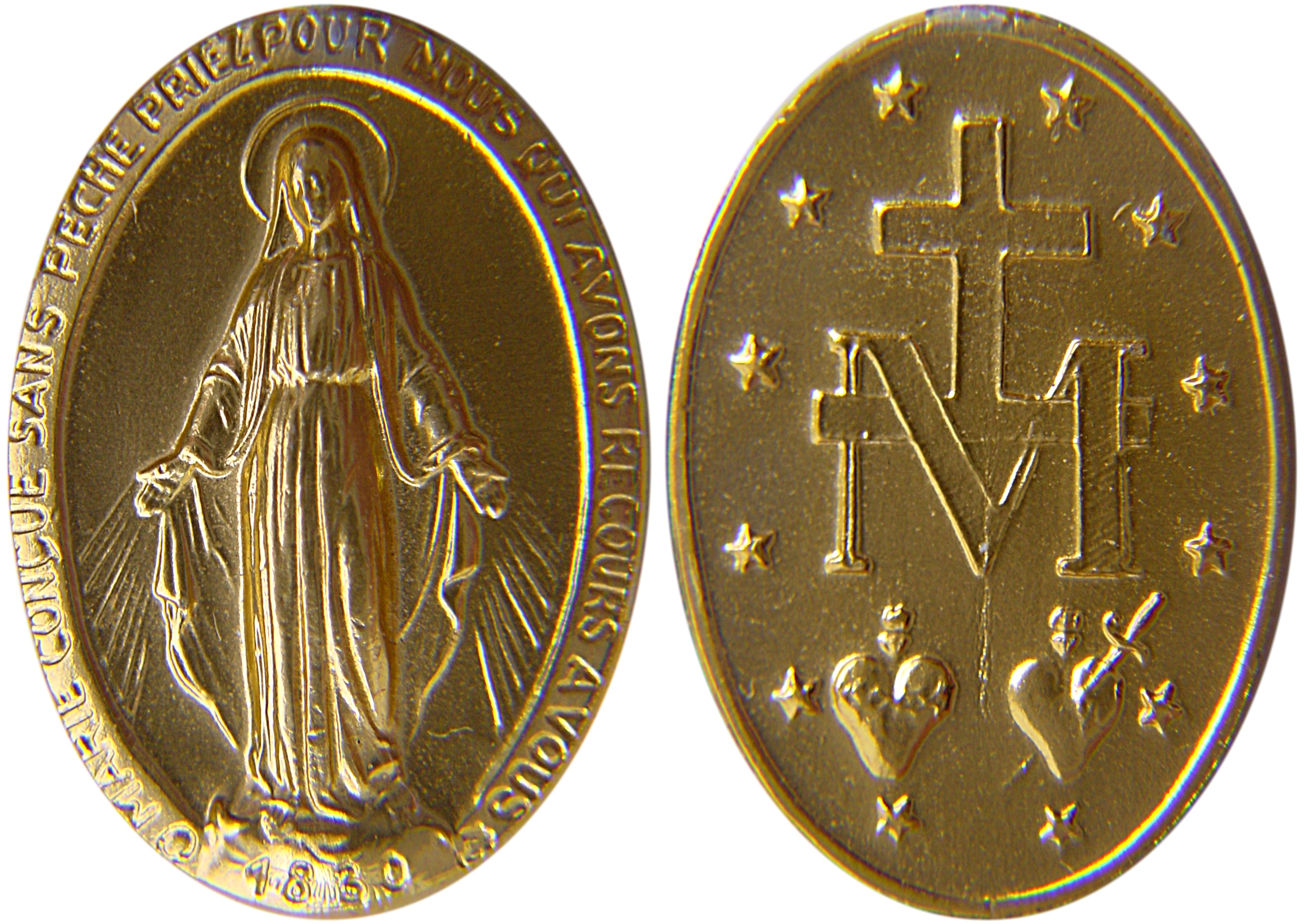 Front and reverse of the Miraculous Medal. The medal is a sign of Marian devotion that directs the faithful toward Jesus Christ; it is not a talisman. Photo by Xhienne, licensed CC BY-SA 3.0/2.5/2.0/1.0 and GFDL, via Wikimedia Commons.
Mary asked that a medal be struck to this design, promising graces to those who wore it with faith. The Archbishop of Paris authorized it in 1832. Reports of extraordinary conversions — most famously that of Alphonse Ratisbonne, a Jewish banker, in a Roman church in 1842 — spread so quickly that popular devotion simply began calling it "the Miraculous Medal." Catherine herself lived out her life quietly as a Sister caring for the elderly, and was canonized in 1947.
The Church's approval of this devotion does not make the apparition part of the deposit of faith. According to CCC 67, private revelations do not complete or improve Christ's definitive Revelation. (Vatican) Their proper role is to help the faithful live the Gospel more fully in a particular period of history. A Catholic may practice this devotion, but must not treat belief in the apparition as equal to faith in Scripture, Sacred Tradition, or defined doctrine.
The promise must be understood within Catholic teaching: graces come from God and are received through a life of faith, prayer, conversion, and perseverance. The medal is never a talisman, insurance policy, or guarantee that suffering and danger will be avoided.
 Immaculate Conception (also called the Immaculate of El Escorial), Bartolomé Esteban Murillo, c. 1660–1665 — the same Marian iconography of light, the globe, and the vanquished serpent that Catherine Labouré reported seeing and that the medal reproduces. (Public Domain, Wikimedia Commons)
Notice what the medal itself says the graces depend on: recourse — turning to — Mary in prayer, who always points to her Son. Nothing on the medal claims the metal disc has power independent of that prayer.
4. The St. Benedict Medal and Other Common Medals
The St. Benedict Medal traces its devotion to St. Benedict of Nursia (c. 480–547), father of Western monasticism, whom tradition credits with using the Sign of the Cross to render attempts to poison him harmless. Its current form was struck by the monks of Monte Cassino for the fourteenth centenary of Benedict's birth in 1880.
The front bears an image of Benedict holding a cross and his Rule, inscribed Eius in obitu nostro praesentia muniamur — "May we be fortified by his presence in the hour of our death." The back bears a cross surrounded by the initials of a traditional Latin prayer of protection. It is typically blessed with a rite that includes a prayer against evil — but exactly as with the Miraculous Medal, its power lies in the Church's blessing and the wearer's faith, not in the disc of metal itself.
 Front and reverse of the St. Benedict Medal, whose symbols and inscriptions express faith in Christ and prayers against temptation and evil. Photo by Gec00, dedicated to the public domain (CC0 1.0) via Wikimedia Commons.
Other common medals — the Sacred Heart, Our Lady of Guadalupe, St. Michael — work the same way: a portable reminder of a relationship with Christ or a saint, worn as a quiet, ongoing act of prayer.
For a detailed explanation of the medal's front and reverse, its inscriptions, history, blessing, and proper Catholic use, read The St. Benedict Medal Explained.
5. The Crucifix: Why Catholics Keep the Body on the Cross
Both the cross and the crucifix are venerable signs of Christian faith. A crucifix — a cross bearing the image of the crucified Christ — places particular emphasis on the historical Passion and sacrificial love of Jesus. It keeps before the faithful the truth proclaimed by St. Paul: "We proclaim Christ crucified" (1 Corinthians 1:23). Catholics deliberately keep the body on the cross rather than displaying an empty one, and the reason is not decorative sentiment. It is a refusal to let the crucifixion become an abstraction.
St. Paul told the Corinthians plainly what he preached: "For I decided to know nothing among you except Jesus Christ and him crucified" (1 Corinthians 2:2). The crucifix keeps that scandal — a God who suffers and dies for love — in front of Catholic eyes daily, in the home, around the neck, on the wall of a classroom or hospital room.
A blessed crucifix is a sacramental in exactly the sense already described: an object set apart to dispose the one who looks at it toward faith, repentance, and love of Christ crucified. It is not a ward or a force field hung on a nail. It is a picture of the actual event by which evil, sin, and death were conquered — and a standing invitation to unite your own suffering to His.
 Christ Crucified, Diego Velázquez, c. 1632, Museo del Prado — one of the most renowned depictions of the crucifixion in Western art. (Public Domain, Wikimedia Commons)
6. The Rest of the Toolbox: Blessed Salt, Scapulars, Candles, Bells, the Cord of St. Joseph, and House Blessings
Holy water, medals, and the crucifix are the sacramentals most Catholics actually own. A few others round out the ordinary Catholic household:
- Blessed salt — an ancient sacramental, once mixed directly into holy water in the older Roman Ritual, used as a sign of preservation and purification, echoing Christ's words that his followers are "the salt of the earth" (Matthew 5:13). For its biblical symbolism, liturgical history, proper blessing, and responsible use, see Blessed Salt: A Forgotten Treasure.
- Scapulars — most famously the Brown Scapular of Our Lady of Mount Carmel, worn as a sign of consecration to Mary and a reminder to live for Christ, never a guarantee of salvation that bypasses a Christian life of grace.
- Holy candles — blessed candles (the Paschal candle above all) signify Christ as "the light of the world" (John 8:12) and are used in the sacraments themselves as well as in private devotion.
- Blessed bells — bells used by the Church can be blessed and set apart for sacred purposes. Large church bells call the Christian community to worship, announce liturgical celebrations, and mark important moments in the life of the faithful. During Mass, a smaller sanctuary or altar bell may be rung shortly before the consecration and as the priest shows the consecrated Host and chalice, according to local custom (General Instruction of the Roman Missal, no. 150). The sound directs the congregation's attention toward the Eucharistic mystery; the bell does not cause the consecration and possesses no magical power.
The Christian use of bells is fundamentally liturgical and communal. Their sound calls people to prayer, announces sacred time, and directs attention toward the worship of God. When a bell has been blessed according to an approved rite, it should be treated respectfully as an object dedicated to sacred use.
Some older Catholic blessings contain petitions that those who hear a church bell may be encouraged toward prayer and that harmful influences may be driven away through God's mercy. Such language must be understood as the Church's prayer to God — not as a claim that sound waves or metal possess independent power over demons, storms, illnesses, or misfortune.
A Catholic should therefore not treat a handheld bell as a spiritual weapon, ring one around a home to diagnose alleged evil, or assume that demons are automatically expelled by its sound. Any spiritual benefit comes from God through the prayer of the Church. Bells point people toward worship, faith, and prayer; they are not magical devices or substitutes for pastoral discernment.
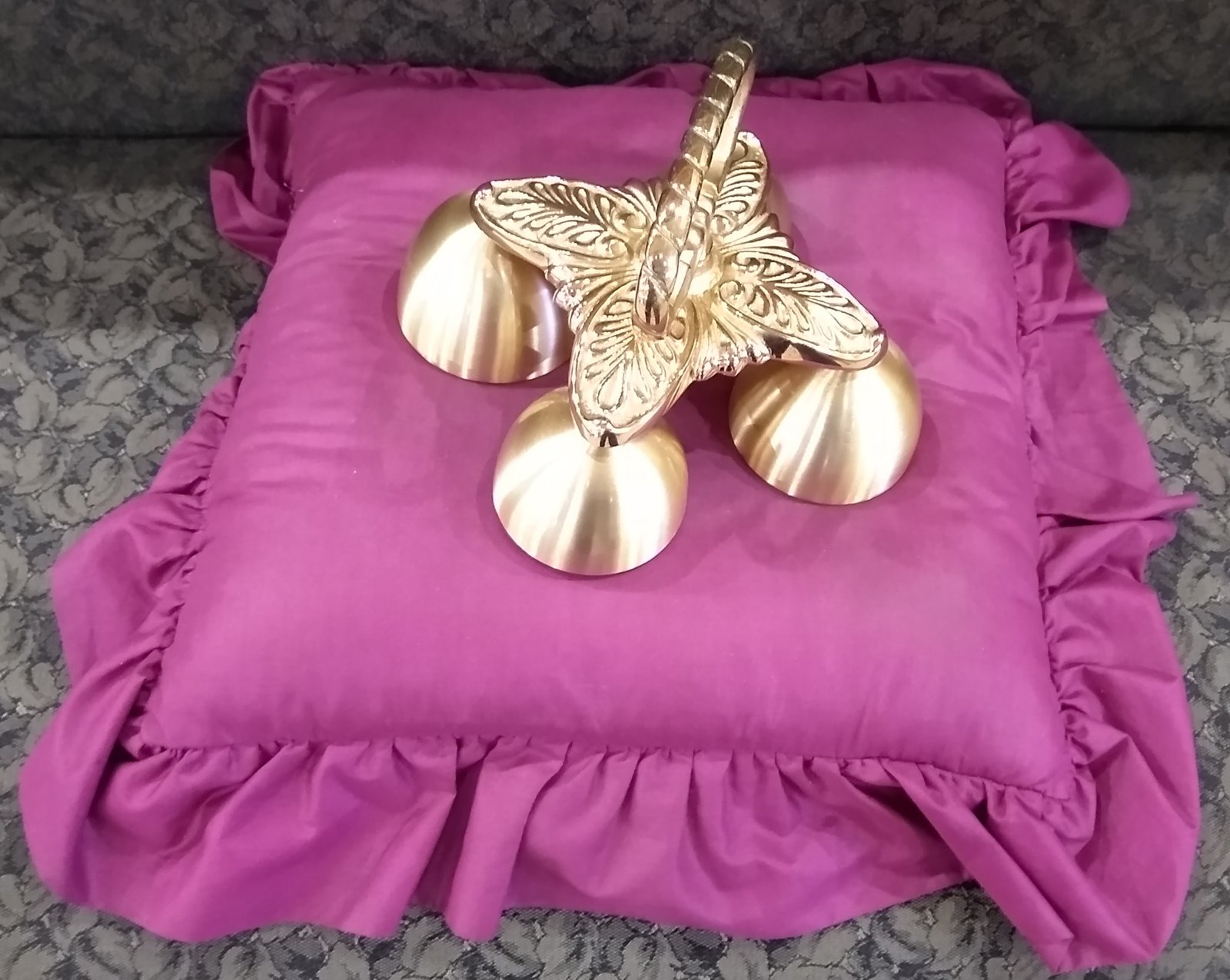 Sanctuary bells may be rung during Mass according to local custom to direct the faithful's attention toward the Eucharistic mystery. Their purpose is liturgical — not magical. Photo by Whoisjohngalt, licensed CC BY-SA 4.0, via Wikimedia Commons.
- The Cord of St. Joseph — also known as the White Cord or Cincture of St. Joseph, this devotional cord is traditionally made from white thread, cotton, or similar material. It commonly bears seven knots recalling the Seven Sorrows and Seven Joys of St. Joseph. It is worn as an outward reminder to imitate St. Joseph's purity, chastity according to one's state of life, humility, obedience, fidelity, and loving service to Jesus and Mary.
The Cord of St. Joseph: A Sign of Purity and Faithfulness
The Cord of St. Joseph belongs to the family of Catholic devotional cords or cinctures. Its white color traditionally signifies purity, while its seven knots recall the Seven Sorrows and Seven Joys of St. Joseph. The cord directs the faithful toward St. Joseph as the chaste husband of Mary, guardian of the Redeemer, faithful servant of God, and model of quiet obedience.
The devotion developed over several centuries. Historical accounts associate its growth with Antwerp in the seventeenth century and with later confraternities devoted to St. Joseph. In the nineteenth century, ecclesiastical authorization was given for particular formulas for blessing St. Joseph cinctures and for confraternities associated with the devotion. Historical details and former indulgences should be presented carefully because particular privileges, enrollment requirements, and older disciplines may have changed. For more on this history, see Oblates of St. Joseph — St. Joseph in the Liturgy and the St. Joseph Cincture.
Those who practice the devotion have traditionally worn the cord around the waist as a reminder of purity and chastity, or in another customary manner associated with obedience. A common devotional practice is to pray seven Glory Be prayers while remembering the Seven Sorrows and Seven Joys of St. Joseph. These customs are devotional disciplines rather than universally binding obligations for Catholics.
The Cord of St. Joseph is not a magical rope, an amulet, or an automatic shield against temptation, illness, demons, accidents, or death. The number of knots, the white color, and the material possess no independent spiritual force. Wearing the cord while deliberately refusing prayer, conversion, chastity, or obedience contradicts its meaning.
Any grace associated with the devotion comes from God through Jesus Christ. Catholics ask for St. Joseph's intercession and use the cord as a tangible reminder to cooperate with grace and imitate his virtues. The cord does not replace Confession, the Eucharist, daily prayer, moral responsibility, medical treatment, or appropriate pastoral care.
Because historical forms of this devotion may use a particular blessing or may be connected with enrollment in a confraternity, the faithful should consult a knowledgeable priest when seeking the traditional form. Do not claim that possessing or wearing an unblessed white cord automatically enrolls someone in an association or grants an indulgence.
 Educational representation of the Cord of St. Joseph. The Cord of St. Joseph traditionally has seven knots recalling his Seven Sorrows and Seven Joys. Its white color signifies purity. It is a devotional reminder to seek God's grace and imitate St. Joseph's chastity, humility, obedience, and faithfulness — not a magical protective rope.
- House blessings — the Church provides approved rites for blessing homes. Depending on the approved rite and diocesan norms, certain blessings may be led by an authorized lay minister, while blessings or pastoral interventions involving alleged extraordinary demonic activity must be referred to the parish priest or diocesan authority. Laypeople must not imitate exorcisms or directly command demons.
All of these follow the sacramental pattern described in Section 1: a sacred sign and the intercessory prayer of the Church, whose spiritual fruits are received according to God’s will and the proper disposition of those who use them.
And God did extraordinary miracles by the hands of Paul, so that handkerchiefs or aprons were carried away from his body to the sick, and diseases left them and the evil spirits came out of them.
— Acts 19:11–12
Scripture itself shows God working through ordinary material objects — cloth that had simply touched the Apostle's skin, carried to the sick by the faith of those who brought them. The cloth had no power of its own; God chose, in His freedom, to work through it in response to faith. That is the same logic underneath every sacramental the Church has approved since.
This passage is not the direct institution of Christian sacramentals. The cloths associated with St. Paul are more closely analogous to contact relics. Nevertheless, the passage demonstrates a broader biblical principle: God, without surrendering His sovereignty, can choose to work through material things. The power remains God's and never belongs independently to the material object.
7. The Theology of Blessing: What Is a Priest Actually Doing?
When a priest or deacon blesses an object, he is not performing a private magic trick, and he is not merely wishing you well the way anyone might say "God bless you" at a sneeze. A liturgical blessing is an act of the Church herself: praise of God for his goodness, and intercession that the person or thing blessed be used according to God's purposes and for the good of those who use it well. (Vatican)
Some blessings are lasting — consecrating persons or things to God in a way that endures — while most simply invoke God's favor without permanently changing the object. Either way, the object itself gains no independent power; what changes is its meaning and use, set apart to point the one who uses it toward God.
The Catechism also notes: "the more a blessing concerns ecclesial and sacramental life, the more is its administration reserved to the ordained ministry" (CCC 1669). (USCCB) Ordained ministers normally impart blessings connected closely with ecclesial and sacramental life. Canon Law also permits qualified laypersons to administer certain sacramentals when the approved liturgical books and the local ordinary allow it (Canon 1168). (Vatican) No one should invent personal rites, use formulas reserved to clergy, or perform a major exorcism. A major exorcism is reserved to a priest who has received the local ordinary's express permission (CCC 1673; Canon 1172).
8. Where Legitimate Use Ends and Superstition Begins
This is the crucial line, and the Catechism draws it with precision. Superstition is defined as "the deviation of religious feeling and of the practices this feeling imposes" (CCC 2111). The Catechism explains that this deviation can affect even true, Church-approved practices, whenever the sheer external performance of a prayer or sacramental sign is treated as automatically effective, apart from the interior dispositions it demands. (Vatican)
Side by side:
Legitimate Catholic use:
"I wear this Miraculous Medal, blessed by a priest, as a sign of my devotion to Our Lady and my trust in her Son. Looking at it reminds me to pray."
Superstition:
"Nothing bad can happen to me as long as I have this medal on, no matter what I do or fail to do."
The first treats the medal as what it is: a sacramental, a prayer-aid, a sign pointing beyond itself to Christ. The second treats it as a talisman — as if the metal itself held a guaranteed force, independent of grace, faith, or how the wearer lives. That confusion turns a good, Church-approved object into an occasion of superstition — the same underlying error this library's article on occult practices addresses from the opposite direction.
The remedy is not to stop using sacramentals. It is to use them as the Church teaches — as helps to faith, never as replacements for it.
What Sacramentals Can and Cannot Do
Sacramentals can:
- invoke God's blessing through the prayer of the Church
- dispose us to receive grace and cooperate with it
- recall Baptism and the Paschal Mystery
- encourage faith, repentance, prayer, and Christian witness
- sanctify the circumstances of ordinary life
- serve as signs of trust in Christ and, where appropriate, confidence in the intercession of Mary and the saints
- call the faithful to worship and direct their attention toward sacred mysteries, as bells do
- remind the faithful to practice particular Christian virtues, as the Cord of St. Joseph recalls purity, humility, obedience, and faithfulness
Sacramentals cannot:
- force God to grant a desired result
- guarantee safety, healing, prosperity, or freedom from suffering
- forgive mortal sin in place of sacramental Confession
- replace Baptism, the Eucharist, Confession, Scripture, or daily prayer
- protect a person who deliberately persists in grave sin as though the object were a spiritual shield
- operate as magic, charms, amulets, or talismans
- authorize laypeople to perform exorcisms reserved by the Church
- make a bell's sound or a cord's material spiritually powerful in itself
- diagnose demonic activity through reactions to a bell, cord, medal, holy water, or other blessed object
- guarantee purity, protection, healing, final perseverance, or salvation without conversion and cooperation with God's grace
Sacramentals, Spiritual Warfare, and Ordinary Catholic Life
Sacramentals belong first to the Church's life of worship and sanctification, not to a culture of fear. Some approved blessings explicitly ask for protection from evil, but sacramentals should never become the center of a Catholic's spiritual life. Authentic spiritual warfare begins with union with Christ: Baptism, faithful participation in the Eucharist, regular Confession, prayer, Scripture, forgiveness, works of charity, and rejection of sin. A Catholic should be more attentive to Christ than to demons and more committed to conversion than to collecting blessed objects.
If a person experiences persistent fear, disturbing phenomena, or suspected spiritual affliction, sacramentals should not be used for self-diagnosis. The appropriate response is calm pastoral discernment through a parish priest, together with medical or psychological care whenever indicated. Sacramentals are not diagnostic instruments, and unusual reactions to them do not prove demonic activity.
Neither the ringing of a blessed bell nor the wearing of the Cord of St. Joseph proves that a person or place is spiritually afflicted. Catholics must not use either object to test for demons, provoke manifestations, or conduct improvised deliverance rituals. The proper use of these sacramentals is Christ-centered prayer, worship, remembrance, and growth in virtue.
9. How to Actually Use a Sacramental Well
A short, practical rule of thumb:
- Have it blessed according to the Church’s approved rite. A medal or crucifix purchased from a store has not necessarily been blessed. Ordinarily, you may bring it to a priest or deacon and ask whether he can impart the appropriate blessing. Certain blessings may also be administered by qualified laypersons when permitted by the approved liturgical books and the local ordinary. The approved rite and its requirements—not personal improvisation—should always be followed.
- Let the object do its actual job: remind you to pray. Every time your hand touches the medal in your pocket, or your eyes fall on the crucifix on the wall, treat it as a cue to pray, to trust, or simply to recall that you belong to Christ.
- Keep your sacramental life alive, not just your sacramental objects. Confession, the Eucharist, Scripture, and daily prayer are what a medal or a splash of holy water is pointing you toward. A house full of blessed objects and an empty prayer life has the theology backwards.
- Never treat the object as a guarantee. A blessed item does not exempt anyone from sin, prudence, or ordinary responsibility. It disposes; it does not compel.
- When in doubt, ask a priest — don't improvise. For a house blessing, or if you are unsure whether something at home should be kept or removed, your parish priest is the right person to ask. This is ordinary pastoral care, not a dramatic request.
Used this way, sacramentals do what the Church says they do: sanctify the ordinary events of Christian life — a home, a car, a meal, a sickbed — so that nothing in a Catholic's life is left untouched by grace. (Vatican)
Key Catholic References
| Source | What It Covers |
|---|---|
| CCC 1667–1673 | The definition of sacramentals, their relationship to the sacraments, and examples (blessings, consecrations, exorcisms). |
| CCC 1674–1676 | Popular piety and devotions, and how they must lead toward, and never replace, the sacred liturgy. |
| CCC 1127–1128 | The efficacy of the sacraments ex opere operato, the contrast point for understanding how sacramentals differ. |
| CCC 1256 | Who may baptize — the ordinary and, in necessity, extraordinary minister of Baptism. |
| CCC 67 | Private revelations do not belong to the deposit of faith and cannot improve or complete Christ's definitive Revelation. |
| CCC 2110–2117 | Superstition (CCC 2111), and its distinction from authentic religion and from divination/magic. |
| Code of Canon Law, Canons 1166–1172 | Sacramentals and who may administer them, including qualified laypersons under Canon 1168 and the reservation of major exorcism under Canon 1172. |
| Directory on Popular Piety and the Liturgy | Guidance on medals, devotions, and popular piety, including that medals are signs of devotion, never talismans (no. 206). |
| USCCB — Sacramentals (Blessings) | A pastoral overview of blessings as sacramentals, and who may administer them. |
| USCCB — Catechism Part 2, Section 2, Chapter 4 | The full text on sacramentals, blessings, and popular piety in the USCCB's presentation of the Catechism. |
A bell calls us to worship; it does not control spiritual forces. The Cord of St. Joseph calls us to purity and faithfulness; it does not guarantee them automatically. Like every authentic sacramental, each directs us beyond the material object toward God, prayer, conversion, and the sacramental life of the Church.
Continue Learning About Sacramentals
| Article | Link |
|---|---|
| Explore All Sacramentals | Browse the library |
| The St. Benedict Medal Explained | Read more |
| Blessed Salt: A Forgotten Treasure | Read more |
Final Message
Hindi bawal ang maniwala sa kapangyarihan ng basbas. Hindi rin ito palagay lang o kunwari — totoong dumarating ang biyaya ng Diyos sa pamamagitan ng mga banal na tanda na ito. Ang mali lang ay kapag inaakala nating ang bagay mismo — ang metal, ang tubig, ang kandila — ang may kapangyarihan, sa halip na ang Diyos na sinasamba natin.
No medal saves by its own power. Jesus Christ alone is the Savior. A blessed medal can nevertheless be a genuine sacramental: through the Church's prayer and the faithful person's proper disposition, it can assist prayer, strengthen remembrance of baptismal commitments, and encourage a life directed toward Christ. A crucifix on your wall will not, by itself, protect your household. Holy water remains blessed water even when someone uses it carelessly; however, a careless or superstitious use fails to express the proper disposition the Church seeks. Its purpose is fulfilled most fruitfully when it is used with faith, prayer, repentance, and trust in Christ. But used as the Church intends — as prayer made tangible, ordinary matter set apart to point your heart back to Christ — these small objects do what centuries of Catholics have found them to do: help you pray, help you remember, and keep you walking toward the God who is their only real source of power.
The medal points to Mary. Mary points to Jesus. Jesus is where every sacramental, rightly understood, was always meant to lead.
Keep the sacramentals. Bless them properly. Use them well. Let every one do the one job they were ever given: draw you deeper into the sacraments, into prayer, and into an ordinary, faithful Catholic life.
Was this article helpful?
Help Us Keep Catholic Formation Faithful
Catholic clergy and qualified formation professionals are invited to review this article or recommend an authoritative source.
Grow closer to God.
Agnioz is here to walk with you.
Register for FREE and unlock more Catholic content, prayers, and reflections to help you become a more enlightened Catholic — FREE FOREVER.


Let's grow together in faith, hope, and love. 🙏